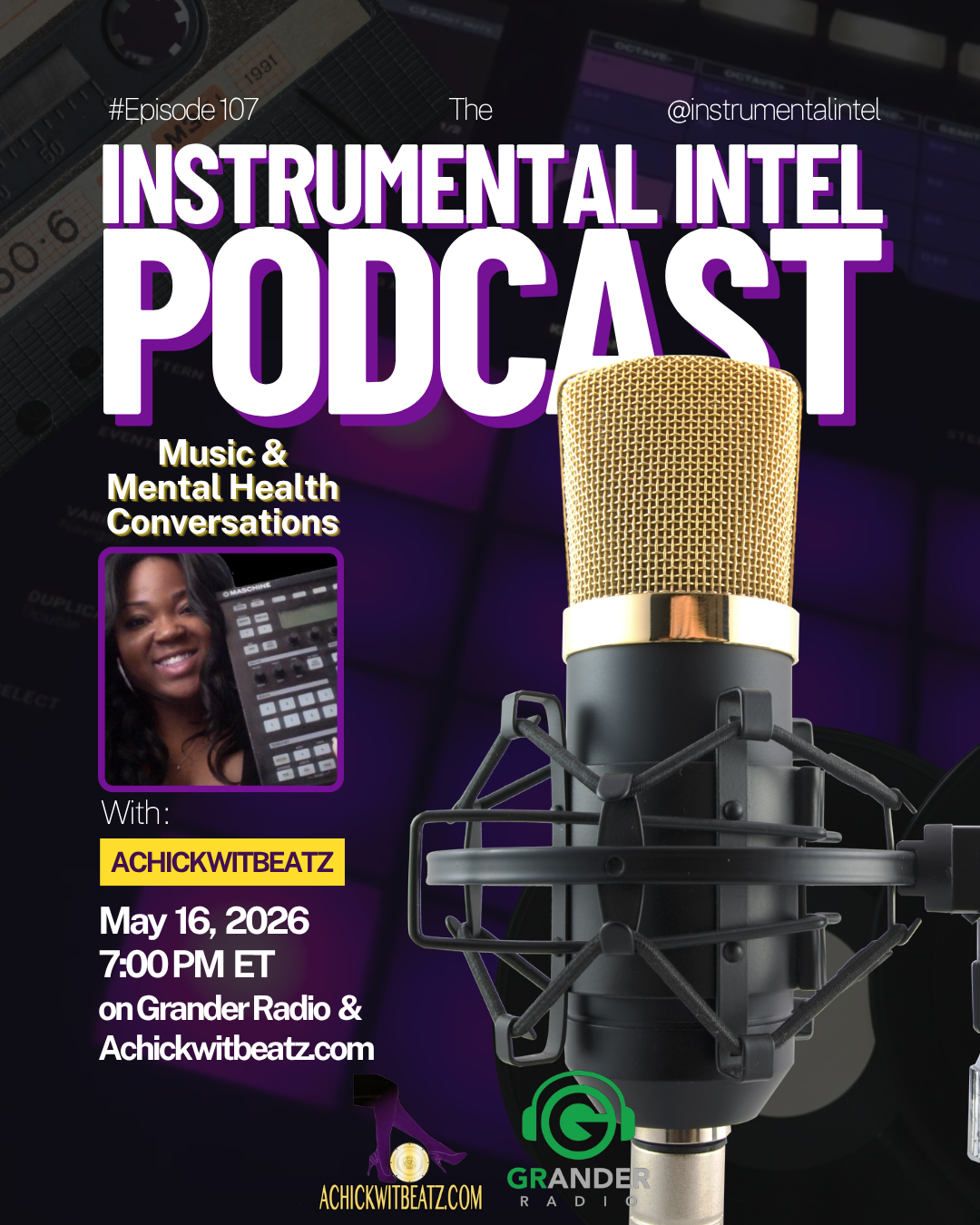
Achickwitbeatz presents the Instrumental Intel podcast, bringing you information instrumental to your artistic career including music industry news & tips, insights & interviews, and beats for your inspiration. Listen on Saturdays at 7 pm EST on Grander Radio and Achickwitbeatz.com.
Follow on Facebook, Instagram, Twitter, YouTube Audiomack & SoundCloud, and subscribe on your favorite podcast platform. Download the Grander Media app to listen to Grander Radio on the go.


- Art
- Independent Labels
- Internet Radio
- Music Documentaries
- Album Reviews
- Music History
- Music Industry News
- Free Game Friday
- Free Downloads
- Poetry
- Books
- Interviews
- Did You See It?!
- Hip Hop History
- Hear Here
- Music News
- Hip Hop Documentaries
- Music Marvels Radio Show
- Think Piece Thursday
- Mini Documentaries
- Instrumental Intel
- Music Humor
- Indie Analysis
- Conversations & Quotables
- Music
- Resources for Artists
- Podcasts
- Beats/Instrumentals
- Music Education
00:01
Hey, thank you so much for tuning in to Instrumental Intel. I'm your host, music producer, Achickwitbeatz. And I'm glad that you're here with me today since May is Mental Health Awareness Month. I'm going to be doing a special show dedicated to the conversations that I've had regarding music and mental health. Just something kind of important to keep in mind. And of course, I've got music industry news for you and beats by me for your inspiration. So before I go ahead and drop that first beat, I've got to give a shout-out to my home station.
00:30
Grander Radio out of Grand Rapids, Michigan. And with that, let's go.
[BEAT BREAK]
04:27
Hey, I'm music producer Achickwitbeatz, back with the music biz brief. First up, Sony Music Publishing has confirmed a deal to acquire Recognition Music Group's catalog of more than 45,000 songs from funds managed by Blackstone, reportedly valued between $3.5 billion and $4 billion. The catalog includes big hits from artists like Beyonce, Fleetwood Mac,
04:50
Lady Gaga, Rihanna, and Journey as the purchase continues the trend of large companies investing heavily in evergreen catalogs and long-term publishing assets. Red Hot Chili Peppers sold their recorded music catalog to Warner Music Group in a deal worth over $300 million. It's yet another major catalog acquisition in an increasingly competitive music rights market.
05:11
as major labels continue partnering with investment firms to expand their catalog holdings and long-term revenue opportunities tied to streaming, licensing, and legacy music consumption. Warner Music Group and Paramount Pictures signed a multi-year deal to develop theatrical films based on the lives and music of Warner artists and songwriters. The partnership follows Warner's recent Netflix deal, focused on documentaries, as the company builds on its strategy to turn artist catalogs
05:37
and music histories into entertainment franchises beyond streaming and recorded music. Universal Music Group and Warner Music Group have signed separate tourism-focused partnerships in Southeast Asia, with Universal teaming up with Singapore's Tourism Board and Warner partnering with Thailand's Tourism Authority to promote travel through music-driven campaigns and artist activation.
05:58
The deal shows growing interest for major labels and expanding beyond traditional music revenue as Southeast Asia emerges as a fast-growing market for music and entertainment. Are you spotting a trend here? Backline, a U.S.-based nonprofit, released an EDM Mental Health Toolkit designed to help electronic music artists, DJs, and others in the sector. The guide arrived shortly after Backline launched B-Line, a 24-hour mental health and crisis support line. For more information, please check out backline.care
06:28
Or you can text 254639 or call 855-B-LINE-99 for 24-7 mental health support for the music industry. Tencent Music says it's removed more than 250,000 policy-violating songs in 2025 and reviewed over 600,000 high-risk copyright cases. The company also removed more than 27,000 tracks with issues like song theft,
06:53
plagiarism and what they're calling trend hijacking, while expanding AI detection tools, label compliance systems, and AI content tagging policies. Tencent says it only uses licensed content for AI training, as some streaming platforms increase enforcement around AI-generated and manipulated content. All right, and say sim, paid out roughly $1.7 billion to composers and publishers in 2025.
07:16
with revenue up 21% year over year to over $2 billion, thanks to growth from international digital platforms and overseas collections. The organization says streaming and global licensing continue to reshape royalty collection, with digital revenue now the primary growth engine along with ongoing investments in technology, rights management, and creator compensation. And finally, Beatport has launched a new Track ID feature in its mobile app that works similarly to Shazam!
07:43
But it's designed specifically for DJs trying to identify songs in club and festival environments. The tool recognizes pitch-shifted tracks, mashups, and songs layered in live DJ sets, while also giving users the option to stream or purchase identified tracks later through Beatport's platform. All right, and that's it for the music biz brief. I'm gonna take a quick pause for the cause, and then I'll be back with some of the conversations that I've had with mental health professionals, Phire Free, and Cinqué Barlow. Keep it locked!
[BEAT BREAK]
12:12
Hey, I'm Achickwitbeatz, multi-genre music producer and strategist to indie artists and labels. Visit achickwitbeatz.com for resources for artists and instrumentals in various genres available for songs, vlogs, blogs, podcasts, themes, TV, film,
12:42
commercials, and more. Once again, that's achickwitbeatz.com. That's A-C-H-I-C-K-W-I-T-B-E-A-T-Z.com. Let's make something happen. My name is Cinqué Barlow. I'm an LCSW, which is a licensed clinical social worker. Kind of uh aside from doctor, PhD, about as high as you can go in the social work field, but I am.
13:11
I'm be looking at that PhD in another field. But anyway, what got me into the field was, it's been a journey. I think I've shared with many and maybe briefly with you. uh It started with some personal stuff, probably like as a teen, uh personal mental health, and just some other personal struggles. uh
13:41
that I overcame, you know, in retrospect, looking back, oh know, majority of the issues were resolved on the surface, by my early 20s, which seems cool, but that was really just the beginning, you know, dealing with the, you know, with the substance abuse and mental health stuff I was going through at the time. That was just the beginning, oh but, you know, embarked on a career that...
14:10
got to a point where I didn't really enjoy it, enjoyed it. Oh, and I really wanted to get into the mental health field. And as we were speaking before the show, I kind of dragged my feet as well. Oh, but actually it all came together nicely because when I was focused and ready, everything just fell into place correctly. I had done school, college at an early age and it just didn't work out.
14:39
Because looking back, I really wasn't ready. I went back and got my bachelor's as an adult. Ah, and I was dead-focused. I knew what I wanted and things just fell into place. It wasn't easy, but things fell into place. Once I finished my grad program, worked in community health centers, worked for a nonprofit.
15:07
uh Also, two local hospitals here in Connecticut. And currently I work for oh a town municipality as the counseling coordinator for the youths in this particular town in Connecticut. So it's been a cool journey, um not easy, ups and downs and everything in between, a lot of frustration and really many points where I
15:37
wanted to and there were points where I did, I just gave up. said, man, forget this. But um no, I didn't. I got back on track, which is the real skill, because we all get sidetracked. You know, so I've done individual and group psychotherapy, worked with adults, adolescents and geriatric population, um inpatient and outpatient behavior of health. uh
16:07
car position. I don't know, it's a mix of everything. It's community-based, it's therapy, it's policy. It's cool. It's kind of like everything I've done kind of led me to where I'm at. So it's all worked out. Okay, that's amazing. Um, you know, and congratulations on your journey. Appreciate it. Yeah, that's really phenomenal. Um, you know,
16:35
since we're talking about mental health and Hip Hop through the years, could you kind of give us a little background on what sparked your love for Hip Hop and maybe some early memories or favorite artists from around that timeframe? Oh, wow. Yeah. It's funny because it's still to this day. That's my, that's my, you know, go to, you know, I think a lot of people look at me and say, why are you listening to that? Like, it's just me. Like,
17:03
You know, I often talk to my friends and stuff and just like, we grew up in the perfect spot in time. know, because Hip Hop uh was kicking off then. And I just feel it hit me and a lot of my generation differently because I look at it, okay, I'm 54 years old, put that out there. uh I look at folks two, three years older than me.
17:32
And at that time, yeah, they were into Hip Hop, but really it was more Gap Band and R&B stuff, you know what I mean? Yeah, they liked Hip Hop, but that wasn't really, but us, just, I mean, it was just, it just spoke to us. So I remember, and it sounds corny, but I remember... um
17:56
hearing, you know, and everyone talks about the song, but it was, it was Rappers Delight because it was a popular song, right? It was just like a pop, hip, you know, fun dance song. But even that pop song, and then yeah, of course there were other hip-hop songs before that, but that was just heavy rotation you heard everywhere. Oh, but as a kid hearing that, it just was distinctly different than...
18:24
other music than singing, rapping versus singing. Like when someone is singing, you can misinterpret words or not get what they're saying. There's no, you can't miss the message. And so that right off the bat just, you know, hit me. And then, you know, going forward, um, I always talk, you know, for me, the game changer was a sucker MCs with Run DMC.
18:53
That song was just, it just took Hip Hop in a whole nother direction. It was just the rawest thing out at the time. And still today, you know, it still rocks. But it was just, of course, it was stripped down beats, just D and Run just talking about what they wanted to talk about.
19:21
You know, and that was the beauty of it. You know, I think a lot of times just us, just in general, we spend a lot of time in our own heads, to ourselves in our own heads. And sometimes that's okay, but a lot of times it's not. And that's the beauty of Hip Hop, being able to express through words, beats, rhymes, your feelings, your thoughts, emotions, all that.
19:51
Um, but yeah, it began back in then, you know, from DMC and then, know, everything I can, you know, the LL, the, the, the late eighties, you know, early nineties with Kane, BDP, all that stuff. So, and again, let me just frame it as I'm by, I'm East Coast biased, know, the Connecticut, New York, New Jersey affiliate. I'm East Coast bias. I got to put that out there. I do listen to everything, but primarily, um,
20:19
You know, I'm East Coast biased. You know, I know that gets a really, really bad rap, but, know, I don't think that there's anything wrong with recognizing where it was born. Do you know what I mean? Like, you know, I don't, I don't feel like somebody should be made to feel bad because they have a preference for where it originated.
20:48
in that particular sound. It doesn't mean that you don't like the other stuff. know, it's just, you have a preference. I don't think that that's a bad thing. Right. I just want to be clear on that. do, you know, so the songs, the artists I mentioned, you know, I just don't want folks saying, well, why didn't you mention, wow, this is me. This is where I grew up. This is what I favor.
21:14
And you know what, honestly speaking, you could sit there and read a list of everyone and somebody's still going to say, well, you didn't name. Right, right, I mean, it's always going to be that person until you block them. know, and my black list is so long, but yeah. So, you know, just a little bit of background, you know, for anybody listening, that's actually how you and I connected on Hip Hop.
21:41
And you know, even though I do laugh at like the Google Plus memes and stuff, know, but I will say like you're one of the highlights that came from that very limited era before they went ahead and shut it down. But yeah, very neat social media experiment. Google. Yeah. Yeah. Very, very small window of good stuff.
22:11
Mostly music-wise good stuff. There were a few circles that were actually worth something. Absolutely. Yeah, that's how you and I connected. Love for Hip Hop and whatnot. So later I learned that you were in mental health. So it just kind of made sense to have this conversation with you, especially with your background in mental health. How would you say that that's influenced your perspective on Hip Hop, especially with...
22:41
themes that kind of mirror struggle and empowerment and whatever may have occurred. What are your thoughts on that? Yeah, exactly. Everything you just said. It's a suit. It's always been comforting. I guess that's the key point. And why has it always been comfortably just everything you said, the empowerment, ah the storytelling, the themes of resilience, uh not giving up.
23:11
keep pushing, being really down and out and about to give up, but no, you keep going. know, social issues, know, political, religious, just everything is in there, which is why I have such an affinity towards the art form, I just feel it is a powerful medium that
23:40
I think all artists need to just ah really take to heart before creating stuff. Not to say everything needs to be profound and have a message, but just understand that as I said at the beginning, what you're saying is directly impacting whoever the listener is, positively or negatively. And I think both you and I have experienced both. I mean, we can be in a bad place and hear a song and that can
24:10
you know, not just necessarily, you know, lift us up, but just, you know, make us feel heard. Like, okay, someone else is going through this type of thing. Oh, music is powerful, you know, the arts are powerful. And Hip Hop has always, for me, ah been kind of like a mirror ah at times. I identify with so much. I'm kind of a... uh
24:40
uh introvert, extrovert, saying whatever you want to say. I can be quiet, but I think a lot of stuff that's in Hip Hop, I think it's things I feel, I've thought, ah sometimes I want to say, but don't. So I identify with so much, and I do listen to a wide variety of music outside of Hip Hop too, but I always come, I mean, that's the number one, always.
25:09
You see all my playlists, I look at all my playlists, but it's always, I look at my favorites list, it's always the Hip Hop updating, you know? Okay, this week, new list. It's always been Hip Hop, yeah, so, anyway. Yeah. You know, I've been admitting lately that, you know, it's been a certain era in my car, just about every time I get into it. Every now and then I try to, you know.
25:36
brush up on some new stuff and keep up with what's going on. But just like you said, like my heart goes right back. So yeah, I typically stick within the golden era and maybe like a little bit of early 2000s. But yeah, so golden era, classic Hip Hop, we're talking 80s to 90s timeframe. So in the early days of Hip Hop, do you think that mental health themes were as openly discussed as they are now? Like whether it's blatant or, you know, kind of understated?
26:06
Absolutely not. You know, the 80s, and I'll even argue, majority of the 90s, folks from, as I say, folks who are not part of the masses, who came from different communities or did not look like the masses, Black and Brown folks and other, you know, minorities, you know, it was not
26:36
something that was talked about. uh I'm even gonna go into how you identify gender-wise, LGBTQIA folks. None of that stuff was talked about or acknowledged. Looking back, retrospectively, I can sit here and say that was a problem, but that's just how it was.
27:02
I know for myself going through what I, and I'll keep it to myself, going through, you know, my challenges, you know, as a teen, young adult in the eighties, like I went through that um pretty much with my family and knowing maybe one or two friends. It just wasn't something that was talked about. Nobody knew about it. um I was ignorant about it. My parents, we had to dig and find information. Oh, so I don't.
27:29
No, and I didn't know anyone who was really in tune with it. So the music I was listening to, I think folks were making music and maybe, you know, I don't know if anyone intentionally said, yeah, I got to, I'm feeling this way. I want to get this out on paper and, you know, get some beats to it. I don't know if it went like that. Maybe it did. Because a lot of, I know in the 80s, a lot of it looking back, we just dealt with it however we could.
28:00
a healthy way, dealing with stress, anxiety. And then, you know, there's other serious, more serious mental health conditions, know, besides, and not that depression and anxiety aren't serious, but, you know, we get into, you know, schizoaffective, schizophrenia, bipolar, all that. That's real stuff. And then if that was going on in the 80s, no one had any clue about that. You know, the average layperson, you know what I mean?
28:29
So, you know, it's a common thing with creative folks, with artists. There's a lot of uh struggles with mental health for various reasons, you know? So, no, don't, to go back to what you said, no, absolutely. I don't feel like um that was really focused on, you know, just from what I heard. I could be wrong, but I don't know. What do you think? Um, what are your... I also kind of have that instinct to say no.
28:58
But then sometimes, you know, when you think about in, you know, bringing up 2pac and Biggie, because no matter who's listening, they know who they are. know, like they're kind of the first ones that come to mind when you think about some of their lyrics and some of their songs, telling you they're dealing with depression, but not saying it. So I think at that time frame, even though those topics were kind of addressed, we didn't really know.
29:27
how to recognize or identify those feelings. you know, maybe this might be a little lesser known, but I think this is something that most people would know is my mind's playing tricks on me. I mean, Scarface basically laid out like, you know, textbook, hey, this isn't cool. I'm having these thoughts because I feel guilty about this. So, you know, even though we wrapped along, knotted our heads or whatever, I don't...
29:56
think that the awareness was on us that they were actually kind of dealing with mental health themes in some of these particular songs. I agree. You know, I, you know, you know, the last joint on Big's album, you know, I remember when the album first came out, I went to the store, got it, played the whole joint and that came on and I was just like, wow. But
30:26
I listened to that probably, I don't know why, it came on probably six months ago. And I had heard of Priorith, but it's just, that's some heavy, heavy, like real stuff. And I remember being that age and listening to it, I'm like, wow. But today, I guess through my journey and what I do for a profession.
30:54
It just hit like a ton of bricks. I'm like, wow. You know, so many tears. Yeah. Yeah. You know, like that song, you know, like, yeah. Yeah. No, but that's what a suicidal. Uh, jeez, can't think the last track on. Yeah, I it is actually suicidal thoughts. So, yeah. Thank you. These. Yeah. So these songs were out there. We knew them.
31:23
We knew these weren't good things, but yeah, I don't think at that timeframe, you know, that's just not what the environment was like, oh, maybe he should see a mental health professional. Cause that's not what we did. That wasn't even something we would say at that time. Right. Yeah. It's like that's life. with it. Right. You're like, that beats hard, man. I it felt good to get that out. Yeah, but it was real.
31:51
I don't know. So, I always say, think in terms of mental health and awareness, like you said, in 2024, I think we're in a fantastic place. Everybody's aware, talking about it. But it can still get confusing. There's a lot of buzzwords and terms and everybody's a Google, therapist, doctor.
32:18
You know, I have this, I know how I should be doing. You know, it's a lot of that too. Yeah, the word trauma has been thoroughly abused and thrown around. Yeah, which is all, know, trauma is all legit, but I'm just saying um maybe there's, no, I think we're in a good place. Let me just stop there. Because awareness is step number one, you know, and that wasn't even there. You said go back 20, 30 years ago, you know, particularly in our communities. It just was not.
32:48
Yeah. So I do appreciate that aspect. Excuse me. Of, you know, the whole wave of mental health and so forth. Yeah. But mean, with that being said, I still think it's a good thing that you brought that up because mental health is so important. You know, we might want to steer away from people who just throw around buzzwords and make sure that you're connecting with an actual professional.
33:17
Well, I kind of ticked off around that, I guess I won't. Yeah, no, you put it out there. Yeah, you know, I have this conversation with a good friend of mine a lot. And it's great that the awareness is out there. But I just, know, you really got to look at the source because it goes from one thing from being, you know, an opinion, something.
33:44
you you've read or seen, you know, but really just, I just say, you know, check your references. Look who's giving you that information. And it's really important because, unfortunately, I've seen a lot of folks putting out, you know, different monikers or titles and it's really like.
34:10
And I won't even put it up, but just you have to check the references. You know, what are the individual's credentials? Are they licensed? You know, really dig into that. Because a lot of folks, you know, it's motivational speaking, it could be coaching. But that, is that person licensed? Because if they're not, it's, a lot of it could be just opinions.
34:34
or what they've experienced, you know, is it evidence-based, you know, what kind of interventions, modalities, like, you know, so all that stuff matters. And I'm not saying everything is bad, absolutely not. I watch videos and, you know, by whomever, you know, of course there's good stuff everywhere, but it is important to check the sources and just leave it there, yeah. Yeah, if you want to get better, you want to make sure you're taking the right medicine.
35:02
right? This is Phire Free. I am a spoken word poet and author. And I am also a master's level um graduate in counseling psychology. I cultivate healing-centered spaces to work
35:26
through trauma and to build on wellness, resilience, and presence and awareness. And thank you so much, Achickwitbeatz, for allowing me to be here today. Yes, I'm glad you could take time from your schedule to share with us. And so, you know, many artists, they're going through challenges and they need places to put their emotions into their music or whatever it is that they do creatively.
35:55
How do you think the process of creating music can help both and challenge mental health for artists? Because we know it's kind of like a double-edged sword a little bit. So what are your thoughts on that? So much. This is a really compound question. And part of my frustration with this is the fact that being in the mental health field and being so dedicated and driven and passionate about trauma, um, and its contribution to things like
36:24
suicidality, so we've had to increase suicide awareness um and self-interest behaviors and challenges just with dealing with and navigating mental illness in general. There just has not, uh there has not been enough effort and interest in making sure that access to creative um outlets have been available.
36:51
Um, and so now it was just recently within the last year or so that it was released that, you know, art and writing is so helpful with trauma. Go figure. Right. So, so to be able to take the time to give people artistic opportunity to kind of delve into.
37:16
reacting and responding to some of their most challenging and some of their most in-depth experiences offers them the opportunity to explore it in a different way. And we really do need to be more open to that culturally. Excellent thought on that. You know, because we do often hear about tortured artists and whatnot. Right. Yeah. What do you think we can do to try to promote like a healthier relationship between creativity and mental health within the industry?
37:47
So within the industry, there's a few specific things. I know for me, I am currently working and creating an offering in a workshop that's called the COPE Life. It's built on reflection and building awareness. However, within the industry, accessibility is a huge aspect. And even though there's been so much work to help people find and gain access, um there also has to be an
38:14
it is a starting point, right? And when schools didn't, when it kind of stopped expanding artistic programs, that's when, where we saw like a lot of major turns and that's an area where we see our youth, our children, especially black children, having a larger, it having a larger impact. So um areas within the industry that could be much more, much better is leading.
38:44
with organizations that start with advocacy, that start with the education, that start with allowing, um that allow spaces and also stop utilizing and leaning into proximity to privilege. um Because there's so many male, like a lot of, one of the biggest issues here is that in Hip Hop specifically,
39:09
It's so male-dominated when we know that it's the women and it's the growth of how we embrace throughout community and cultivate the ability to have our own personal self-determination that has allowed Hip Hop to really flourish. And so we really should not be leaning into what is status quo. Hip Hop was started off from pushing against it. We should continue that push.
39:38
Oh, I think I might need to add an air horn there at some point. Yeah. mean, you know, you're so right. Could you kind of expound a little bit on, you know, those spaces, if you will, and, you know, what we can do to kind of make it safer to kind of push back against the system instead of what they're trying to do, especially thinking about how Hip Hop has been kind of infiltrated.
40:05
you know, as far as content goes. Could you expand on that a little more? So shout out to Tiffany Redd, who has a business called 100 Percenters, focusing on, you know, issues around sexual assault and things that change the trajectory in her career. She has taken up advocating for writers and making sure that writers get talking to writers and talking to
40:33
people in charge of projects to making sure that writers are appropriately respected on their projects. Um, there are a lot of people who are working to kind of change the game and working to uh create stronger spaces because let's be real, like if writers and producers and artists weren't making the product, nobody would be making any money.
41:01
And with that stated, like, one of the biggest issues is the business decided to formulate Hip Hop. And I think you and I have discussed this a fair amount, that Hip Hop has been so formulaic that the pushback, the innovation has had to change so much. And yet at the same time, some of the very grassroots interests aren't even being supported the way that they need to be supported. I know that
41:30
You know, a solid example in my career, I will use myself, is like, love art, I love Hip Hop, I love writing, and I had to structure myself in a way that made me marketable to capitalism as opposed to capitalism adapting to make what I do more valuable. And so, you know,
42:00
within all that adaptation, years get lost, time gets lost. um So trying to find the outlets becomes more of a challenge and it devours time. And there's a lot of people who have had to shift, pivot, transition, take, some of us are wearing multiple hats and yeah, it's just,
42:29
at what point in a lot of times we see ourselves giving who we are up to fit something that was never made to fit us in the first place. And so that's one of the aspects of coming out now as I have with the ownership of the fact that I am a writer and a poet and the goal is to be able to assist and support people in processing their trauma, recognizing their own fears, understanding
42:58
uh you know, what they're going through and what's happening to them and what's impacting them. These are all things that, you know, if the world were more open to the fact of accepting people to create it, create the space as opposed to fitting, making themselves fit in a, like making, you know, making their circle peg fit in a square knob, then we wouldn't, we wouldn't.
43:27
lose so much time, we could move faster, it could be more innovative, there could be more room to bring in variations of beautiful things that create space. And with Hip Hop becoming so formulaic to fit a business and an industry, a lot of the mental health and a lot of the aspects that are mindful and beautiful for people are lost.
43:54
I'm going to just say one more thing. Like that's one of the things that we saw with Andre 3000, right? We see him dominating the game. He's at the top. Outkast is everywhere. And then they just drop off. Then my man comes out and shares about issues and challenges with depression. And, you know, we were like, okay, where are you? And the next release that he has is a, you know, an instrumental. uh
44:23
which everybody appreciated. However, you know, where was the space for that? You know, if it wasn't so formulaic, he would have been able to do that and probably, you know, and then some. You know, that's such an excellent example because I mean, for those of us who got to witness Outkast in real time, we got to see his evolution.
44:52
I mean, it was incredible, incredible. Every album, you know, and not just him, know, big boy too. Shout out to him. out boy. Yeah. So yeah, you could literally see the growth happening in real time. So, even though there were a lot of memes about the flute album and whatnot, honestly, was anybody really surprised? Because if you were paying attention, you saw that he was growing and expanding.
45:18
Absolutely. Yeah. mean, and think about how Hip Hop was formed. A lot of people were taking, you know, either disco or jazz records and like scratching them up. So it's a natural evolution that is not as weird as some people try to make it out to be. So organic. So like this is, uh is so organic and we really have grown, but we're still trying to stick in this little box that just, it just wasn't meant to stay in.
45:48
It's not a movie, you know? It's not meant to be the same thing over and over and over again. Like at some point, like we've grown, we've moved forward. Even our greatest makers have moved on to other things because they've been too restricted. Yeah, yeah. Jean Grae had said recently that they're not going to be making rap music anymore, which perfectly makes sense.
46:17
because especially if they were putting their effort into it constantly, and I mean, the thought process that just had to go into writing their lyrics all the time. I mean, how could you not get burned out, especially when you feel like it's not being reciprocated? Like the fans aren't like, oh, thank you. This is what I needed because anytime you do one thing, you know, as an artist, a lot of times you kind of want to grow and do something different in order to push yourself, you know, and push past your boundaries.
46:47
It means you've got to take some chances that not everyone's going to understand. And I think even as fans, as listeners, which many artists are, we kind of have to offer that same grace to some of our favorite artists as well. And that's something that I don't see happening very often. How about you? Oh my goodness. So to expand off of that, right? And I know I kind of, to explain what I say when I'm like, this is not a movie. So essentially,
47:14
A movie is a beautiful piece of art that can expand on thoughts, right? But at some point you're watching the same thing over again when you start from the beginning and go to the end. It's the same thing. Nothing is ever going to change, right? And when we create art in living in real time, when we create our art, there is an expansion. Even when you go back to the beginning, there's something that shifts or changes or something.
47:44
becomes new, uh new ideas, spin on new ideas and it grows. And so in real time, as we live, we're not going to, even with our own art, we're not gonna experience it the same. We're not going to grow the same. And we recognize, especially with this new generation, that yeah, they may like what we put out. They may love it. They may like to listen to it over and over and over again, but they're growing as we grow.
48:14
Yeah, that's what Hip Hop is. It's what it allows. It's what it makes room for. So to talk about, you know, Jean Grae, who is also somebody that we've watched grow and expand and learn and just journey. Like, of course they're going to get burnt out. They can't keep doing the same things.
48:39
And they've been trying to expand and grow for a while with the series and just different projects. And so I'm excited for them. At the same time, it's disappointing. But there's that whole aspect that we all know. Like, yeah, the game isn't meant, like the game is created to almost stunt growth.
49:09
For us, know how to create new rules. We know how to create new variables and engage in new things. And so we really do need to be open to that. Yes, absolutely. Thank you. Eh, well, thank you. That was fantastic. So with that being said, since there are, I guess,
49:38
lots of ways that the growth is being stifled. You know, there's a lot of temptation to kind of switch what you're doing to mirror what you're seeing happening. That's kind of raking in the big bucks. you know, as we kind of alluded to, there's no way that that's not going to kind of wear down on you after a while. um So since a lot of us are feeling this in different ways and, you know, collaboration just happens to be a really big part of the music world.
50:08
How do you think artists can support each other's mental health, like within the creative circles? Especially with everything that's going on right now, I definitely encourage checking in, seeing how people are doing. And this is a beautiful time. I know we like to have, you know, structured plans and things, but also giving room to being open to what comes up… um because I don't know.
50:36
if you feel like you were impacted by the eclipse m or any of the things that kind of happened to create shifts in real time. Sometimes things like that may have an impact and might shift some things. It might change energy. Um, just some of the side factors. So if we were, if we took more time to just
51:05
sit in the space and ask ourselves, you know, how am I doing? And then ask your, ask who you're collaborating with. How are you doing? Um, that opens up a conversation to kind of adjust for that. Yeah, that's excellent. Oh, since you asked or had mentioned, you know, if the eclipse had affected me, I think in certain ways it maybe
51:33
did more indirectly in the sense that my social media, the things that were on my timeline, the energy was just so off and off-putting. I actually kind of tried to steer away from just scrolling in general and kind of limiting my interactions to things that I felt were a little more positive.
51:57
So, you know, with that being said, even with the question that I asked you, that might've been a good time for me to check in with some of those people where I was seeing this kind of rough energy, like, ooh, are you okay? But, know, like, yeah, I'm glad you presented it that way, because I don't think that I would have thought about it like that, but that was right around that timeframe. You know, was a lot of negativity, a lot of complaints, a lot of, you know, misinterpretation, especially
52:26
Okay, so I didn't intend to talk about this right now, but with the whole conversation with the back and forth with Kendrick and Cole and, you know, is Drake gonna say something, that sort of thing with all that energy going on. I saw grown men get really, really sensitive and almost offended by other people's positions depending on what they thought about one or all three of these artists.
52:54
And, you know, that's not something normally that I would see occur. And now I'm like, okay, you can blame it on the impending eclipse that was going on. But yeah, like it was a lot of, um, man, like people took it personally. It was almost as if those artists thought that somebody said, Hey, I hate your music, man. And really, they're just talking about the celebrity that doesn't even know that they exist. So yeah. You know, with that being said, when I see stuff going on like that, and I'm like, okay.
53:23
That's enough of this for today. I know how to pop off, you know, just kind of let it breathe, do what it does. Yeah. But you know, I don't think, I'm not sure if a lot of artists kind of catch stuff like that. And I believe social media kind of plays a huge role in the lives of artists. So if they're constantly taking in, you know, this type of negativity, how could you recommend that they kind of maintain a positive mental state? Not saying that they have to log off, but you know, do you have any tips for them to kind of be aware?
53:53
of maybe how they're feeling as they're looking at some of the stuff that's going on and if it's affecting them in their mental health or their mood. Man, so with social media, social media is a very interesting thing. And because there are so many factors, you got algorithms, you got content, you got the trending topics, it's a lot. And so I think for one thing,
54:22
um specifically for artists preparing for social media. I know that a lot of times people prepare themselves for what they're for, you know, the time they're going to spend on it, the and the energy that they're going to put into it, but also prepare for what the energy might get out of it, especially depending on what the trending topics are and being grounded in oh understanding, you know, what is the conversation.
54:50
I know that conversation around Kendrick and J. Cole and Drake. Actually, the conversation is very interesting because a lot of people like to put unique spins on that. sometimes it might be better to also offer and open up to what different spins look like. know, shout out to Donna Wright.
55:16
um who did a really cool breakdown of it and um coverage of it and also offers, always offers a really clear and thoughtful insight into um Hip Hop through, from the perspective, from a very thoughtful um scholarly type perspective. um
55:44
So I encourage people to change the dynamic a little bit. Open it up, see what other people are saying. Look at other blogs, look at content creators, look at things that are going to allow some variation to kind of balance the energy. Because sometimes that is part of the imbalance, right? When it's all leaning in one particular direction, that can set anybody off balance.
56:13
And then also be mindful of your own thoughts on it too. um Because I know a lot of people do love Drake and a lot of people do love J. Cole and a lot of people do love um Kendrick. And so being mindful that if you love one of them, it's OK for people who may not necessarily agree with you. Ah, it's OK for somebody to think that somebody else is great. OK. So. uh
56:42
You know, somebody might come in and be like, I don't mess with none of them. Yeah. Yeah. Yeah. Yeah. I appreciate you for saying that. Because I mean, honestly, why would you be upset about that unless you only liked them because you thought everybody liked them? know, mean, that's I mean, you know, hey, if somebody out there listening, got a different opinion.
57:11
You know, free to let me know, but you know, why would it bother you? I know who I have as my favorite lyricist, MC, rapper, but I know that there are people that don't like him for the specific reasons why I do and that's okay. I don't get upset by that because we're all different. But yeah, other than that, I can't see another reason to be that in your feelings unless you thought that you were kind of with the crowd and then now you're finding out that you're not.
57:39
You know, I think that that's something that could probably shake people to their cores as well. So, yeah, I don't know. It's a theory. just you just touched on a huge identity piece. That's that mental health-wise, right? Like identity and self-determination is really huge. So if I if I'm like, hey, I'm in the end crowd and everybody and everybody agrees with me and then there's this big division. Yeah. Like, where's my community? Yeah. Y'all love me by myself.
58:08
Right. Not even realizing that half of us weren't there. It was just because you kept looking at the same blogs and not expanding, like you just said. You know, you're looking for people that just agree with your train of thought already, but not realizing that many of us haven't been on that board. Like we said this in the beginning, you weren't paying attention and labeled everybody haters.
58:33
The echo chamber. Yes. echo chambers. Absolutely. It's hard to believe that, yeah, like that goes back into the frame, right? Like it's hard to believe that it is just that formulaic, yes, people, your gossip blogs get bought. Yes.
58:57
The labels own a chunk of the blogs that you're reading. This is common knowledge. Unless you're literally covering your eyes when these deals happen. I mean, you've got to consider the source. You really got to consider the source. Do you think that people are going that deep? I mean, I agree. We should be going that deep, but... No, you're absolutely not going that deep.
59:22
But yeah, I say that to say you got to pay attention to where the news that you're getting is coming from. And if it doesn't align with your thoughts, it doesn't mean that your thoughts are wrong. You know, just because you read something doesn't mean that you have to change your mindset. All right. And that's a wrap for this episode of Instrumental Intel. I've been your host, music producer Achickwitbeatz. Once again, I'd like to thank you for tuning in. I'd like to thank my home station, Grander Radio out of Grand Rapids, Michigan.
59:50
And make sure that you come back next week. I’ve got more goodness lined up for you. So till next time, you know where to find me. Tune in, tell a friend. I'll see you then. Peace.


![Hear Here: Achickwitbeatz - Dopamine & Serotonin [Single]](https://images.squarespace-cdn.com/content/v1/52b0b90ae4b0293bfed0d692/1710852808557-EZYGFDIBHLBSIRFOVS1Q/Dopamine+%26+Serotonin.JPG)






![Hear Here: Dagga Man- "Analytics" [Prod. by Achickwitbeatz]](https://images.squarespace-cdn.com/content/v1/52b0b90ae4b0293bfed0d692/1584638158548-9R55AZLWZIDFJC8LATV6/IMG_2212.JPG)







![Making Music on a Budget [Infographic]](https://images.squarespace-cdn.com/content/v1/52b0b90ae4b0293bfed0d692/1582844361438-3JTE5NT3EL51FHXC0WJI/making-music-on_1929722%25281%2529.jpg)

A homage to the golden era of 1990s instrumental beat vinyl. Crafted as the perfect partner for freestyling MCs, dancers, and DJ culture. | Visit Achickwitbeatz.com for your instrumental needs & dope stuff for music lovers.