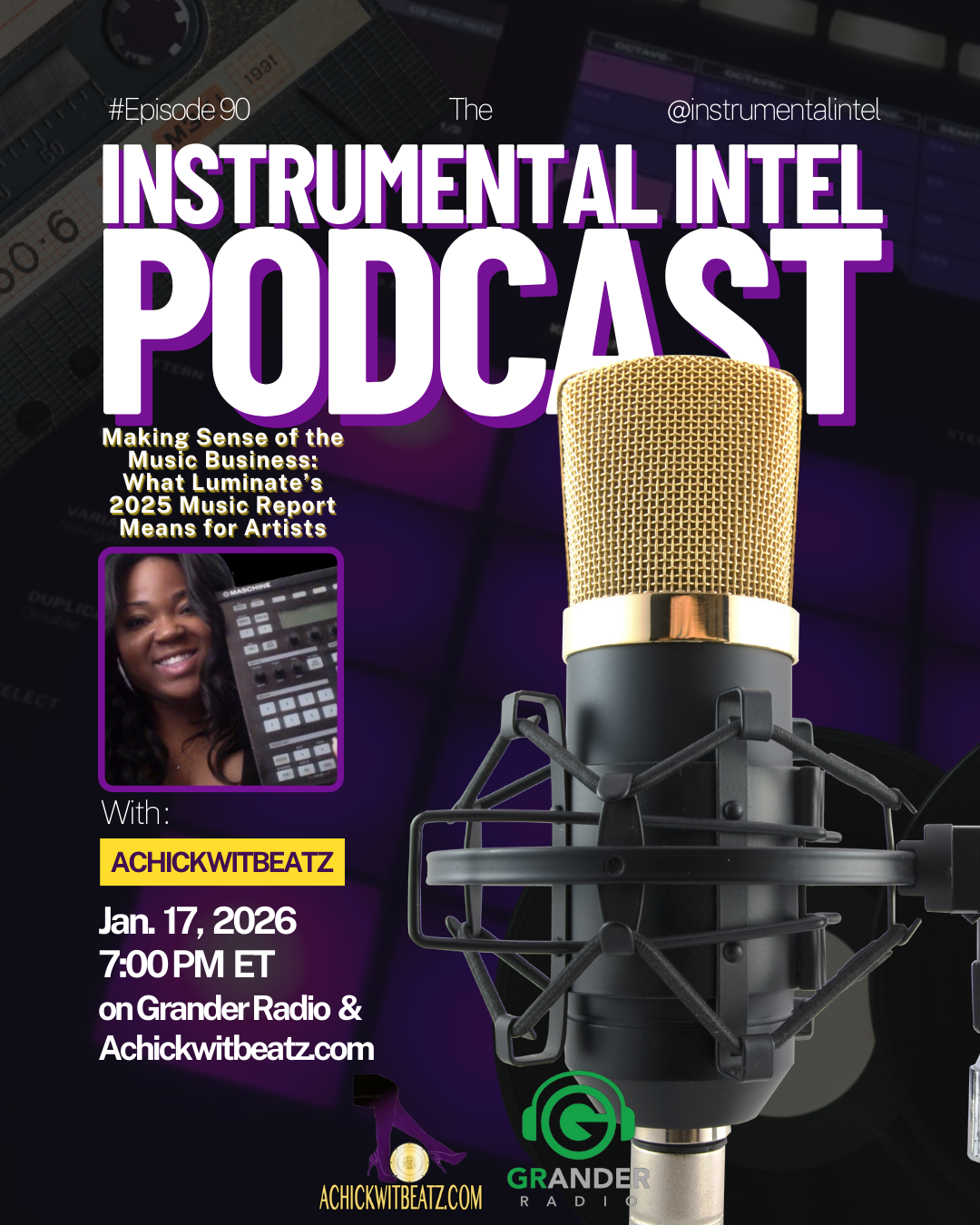
Achickwitbeatz presents the Instrumental Intel podcast, bringing you information instrumental to your artistic career including music industry news & tips, insights & interviews, and beats for your inspiration. Listen on Saturdays at 7 pm EST on Grander Radio and Achickwitbeatz.com.
Follow on Facebook, Instagram, Twitter, YouTube Audiomack & SoundCloud, and subscribe on your favorite podcast platform. Download the Grander Media app to listen to Grander Radio on the go.


- Art
- Independent Labels
- Internet Radio
- Music Documentaries
- Album Reviews
- Music History
- Music Industry News
- Free Game Friday
- Free Downloads
- Poetry
- Books
- Interviews
- Did You See It?!
- Hip Hop History
- Hear Here
- Music News
- Hip Hop Documentaries
- Music Marvels Radio Show
- Think Piece Thursday
- Mini Documentaries
- Instrumental Intel
- Music Humor
- Indie Analysis
- Conversations & Quotables
- Music
- Resources for Artists
- Podcasts
- Beats/Instrumentals
- Music Education
00:00
Hey, thank you so much for tuning in to Instrumental Intel. I am your host, music producer, Achickwitbeatz. And I'm glad that you're here with me. Today's episode has music industry news, instrumentals by me for your inspiration, and later, I'm going to be talking about making sense of the music business. And we're going to talk a little bit about Luminate's 2025 Year-End Music Report and what that actually means for artists. So yeah, gonna kind of get into that. So I'm excited to be bringing this episode to you. And of course, before I go ahead and drop that first beat,
00:30
As always, I gotta give a shout out to my home station, Grander Radio out of Grand Rapids, Michigan. And with that, let's go!
[BEAT BREAK]
11:17
Hey, this is music producer Achickwitbeatz, and you're listening to my podcast Instrumental Intel.
[BEAT BREAK]
17:15
Hey, I'm Achickwitbeatz, multi-genre music producer and strategist to indie artists and labels. Visit achickwitbeatz.com for resources for artists and instrumentals in various genres available for songs, vlogs, blogs, podcasts, themes, TV, film, commercials, and more. Once again, that's achickwitbeatz.com. That's A-C-H-I-C-K-W-I-T-B-E-A-T-Z.com. Let's make something happen.
17:45
Alright, I'm music producer Achickwitbeatz back with the music biz brief. First up, Bandcamp announced it's banning music generated entirely or mostly by AI in an attempt to protect human creators and make sure fans can trust that music on the platform is made by people. It's going to rely on user reports and reserve the right to remove content suspected of heavy AI use. Their decision draws a clear line in favor of human-made music at a time when listener comfort and streaming platform response to AI-created songs remains mixed.
18:15
The US Appeals Court ruled that when songwriters reclaim copyrights using termination rights, those rights can revert globally, not just in the US. This challenges the long-standing publishing norms and could keep publishers from holding foreign rights or revenue on decades-old deals. The decision came from a dispute over a 1963 song involving songwriter Cyril Vetter, and as long as it stands, it's a big win for creator rights and gives songwriters leverage.
18:41
Now would like to make a note, in the recent Salt-N-Pepa termination rights case that got dismissed, the court clarified that the group never owned the copyrights to their early recordings. They granted that ownership to their first label, which was Hurby “Luv Bug” Azur’s Noise in the Attic, so they can't, in essence, revert back to someone that never owned them. But for all artists who have not experienced something like that, it's good news.
19:05
So this also serves as a reminder to be careful of what you're signing, even if it's somebody that you're kind of cool with. You never really know how much of the business they know or some of the details that you may have overlooked. Word to the wise. Merlin has confirmed its 2026-27 board, adding five new global representatives from independent labels and distributors in Nigeria, Japan, Portugal,
19:31
Germany, and the UK. The board was elected by Merlin's membership of tens of thousands of independent music companies and now represents around 15 % of the global recorded music market across Africa, Asia, Europe, Latin America, North America, and Oceania. SXSW Sydney, the Australian offshoot of the iconic festival,
19:51
has been canceled after the New South Wales government withdrew funding despite a 15 % attendance increase in 2025 and a three-year economic impact of 270 million Australian dollars, which is roughly 184 million US dollars. The organizers say it's due to a change in the global environment affecting festivals worldwide. However, SXSW still has an international presence with events like SXSW London, which was launched last year in ‘25.
20:19
Atlantic Screen Group secured $30 million from Corrum Capital to expand its film and TV score and music catalog acquisitions. The London-based company manages publishing administration for over 50 clients worldwide and will use the funding to grow its portfolio of screen music and song catalogs while continuing to offer syncing creative services through its Nightjar Music and Nightjar Songs Publishing divisions.
20:42
Spotify is raising premium subscription prices in the US from $11.99 to $12.99 per month, with Estonia and Latvia markets to see increases as well. The company frames the increase as supporting platform improvements and artist benefits, but we know artists only see a tiny fraction of the revenue from those streams. So yeah, we'll see who that actually helps. Chances are it's not us. But changes are set to take effect in February of this year.
21:07
Alright, that's it for the music biz brief. Since Luminate did release their 2025 year-end report on January 14th, I'm actually going to talk about that in a special segment because it kind of deserves a deep dive. So I'm going to take a quick pause for the cause, and then I'll be back to talk about what their music report means for artists. Keep it locked!
[BEAT BREAK]
27:38
Hey, this is music producer Achickwitbeatz, and you're listening to my podcast Instrumental Intel.
[BEAT BREAK]
33:12
Hey, I'm Achickwitbeatz, multi-genre music producer and strategist to indie artists and labels. Visit achickwitbeatz.com for resources for artists and instrumentals in various genres available for songs, vlogs, blogs, podcasts, themes, TV, film, commercials, and more. Once again, that's achickwitbeatz.com. That's A-C-H-I-C-K-W-I-T-B-E-A-T-Z.com. Let's make something happen.
33:42
Alright, I am music producer Achickwitbeatz, and I'm back with making sense of the music business, what Luminate's 2025 music report means for artists. So Luminate recently released their 2025 Year-End Music Report this past Wednesday, January 14th. I did get a chance to sit in on that webinar, and I found it very informative. So I just kind of wanted to get into it a little bit and kind of break down what it actually means for music artists who are building careers right now.
34:12
especially independent ones. Because if you just skim the headlines, you'll walk away thinking, okay, streaming is still growing and everything's fine, but when you slow down to look at the data, a very different picture starts to emerge. So what Luminate's report is showing us is that the music industry didn't slow down in 2025, but it changed gears. So a lot of the old assumptions that artists have been operating under don't really apply anymore.
34:37
So, to start with the big picture, globally, on-demand audio streaming grew nearly 10 % year over year. That sounds healthy, but in the US, growth was a lot smaller and sometimes flat. So the reality is, this is a mature market now. The days of growth at all costs are over, and platforms are squeezing more value out of existing listeners instead of racing to add new ones. So for artists, this matters because growth isn't really evenly distributed anymore. Attention, revenue, and opportunity
35:06
are kind of consolidating, not disappearing, but you know, just getting a little more concentrated. So this is a stat that you need to be aware of to kind of recalibrate how you're thinking about releasing music. In 2025, over 106,000 new international standard recording codes were delivered to digital service providers every single day. And over 96 % of that distribution came from independent and DIY sources.
35:32
So if you take a minute to think about that, the barrier to release music has gotten lower, but that also means that the competition for attention has never been higher than it is right now. So most new tracks never meaningfully enter the marketplace. Matter of fact, Luminate shows that 88 % of all tracks on DSPs have 1000 streams or fewer. So now we've been talking about this for a while, independent artists know, like ever since that threshold was changed on Spotify, can kind of be tricky.
36:02
But to know that 88 % of all those tracks have less than that just kind of highlights that, you know, there's a huge visibility issue. And this is typically where a lot of artists kind of get discouraged because they think that success equals, you know, going viral, or if you don't go viral, that it means that you're obscure. But the data tells us a story that's a lot more optimistic than that. So when you look at the global streaming pyramid, nearly half of all music consumption comes from tracks that are sitting between 1,000,000-
36:31
50,000,000 streams. So that's not even the billion stream monsters, not the songs with 200 plays, but you know right there in the middle. And right now, that middle tier is actually the backbone of the music economy. So for independent artists, this is really important. It means that sustainability doesn't come from chasing a viral miracle, so you don't have to stress too hard trying to come up with content to promote your music. It does need to happen, but going viral is not gonna do it for you.
36:55
It actually comes from building enough momentum, consistency, and audience trust to live in that middle tier, which is where the catalogs last, the fans return, and revenue just keeps coming in. So speaking of those catalogs, nearly half of all US streams now come from music that was released more than five years ago. So this confirms something that a lot of artists have already been feeling intuitively, but don't always act on.
37:20
So your back catalog, and you know you've heard me say this before, but your back catalog is not dead weight. It might be old to you, but it's new to someone else. And especially if you're making quality music, it's timeless, it's evergreen, and you can still keep kind of vibing off of that. So anytime you chase these trends, the music kind of loses a little weight. And I think that that's what we've been seeing over these last five years, which is why some of these older catalogs are actually doing better. So yeah, think of your catalog as your long-term asset.
37:48
So these catalogs are being used for short-form video, film placements, gaming integrations, all this stuff that's keeping them alive, sometimes for years. mean, talked about this on the old podcast with Fleetwood Mac's Dreams, still pulling massive numbers after it went viral with Doggface's TikTok. So yeah, sometimes it just takes those moments to kind of give it like…a resurgence. We see it happen all the time, especially with short-form video and movies, and TV shows.
38:15
Google dials Iris surged again due to film and social content. So for independent artists, it's important to remember that releasing music isn't a one-week event. You gotta keep going for rediscovery. All right, now, to switch it over to talk about genres, because this is kind of where your strategy starts to matter. So in the US, the highest growth genres by streaming share weren't what most people expected. Rock, Christian/Gospel, and Latin actually saw the biggest gains.
38:42
Rock's share of US audio streaming grew more than any other genre in the US. So yeah, now this doesn't mean that you need to just suddenly switch genres, but it does tell you something important. So audiences are after what's actually resonating with them, not what's just being pushed on them. So they're gravitating towards music that offers identity, things that mean something to them, or it's kind of emotionally grounding. So with Christian and Gospel's growth in particular, it shows you how strong community-based fandom can be.
39:11
So these audiences don't just stream, but they're actually showing up at shows, getting merch, and just being completely engaged. So that kind of relationship is something independent artists can kind of cultivate regardless of what genre that you're in. Just kind of keep that in mind. All right, now for the money. Because streams alone don't tell you the whole story, but Luminate shows that paid streaming users make up less than half of the US population, but account for over three-quarters of all music spending.
39:39
Alright, so the importance of premium listeners kinda depends on like where you're at, but of course, we know that streams from premium listeners typically generate more money for now, even though there is talk about actually switching that, but we'll have to see where that plays out.
39:52
Genres differ in where their audiences live, so rock listeners kind of overindex on Apple Music, country listeners are on Amazon Music, and Latin and Jazz audiences are especially strong on YouTube. So this is just kind of practical intelligence. You can always dig a little bit deeper to find out more about your specific niche or what you're trying to do, but it's important to know because, you know, just kind of marketing blindly across all the platforms isn't really going to help you, but knowing where your listeners actually spend time and money is now more important than ever.
40:21
Another important tidbit is that physical music is still outperforming expectations. Vinyl sales grew for the 19th straight year. I bet some of you probably remember when people saying that the resurgence was just a fad. Spoiler alert, it was not. Direct-to-consumer sales increased again, and more than 40 % of vinyl purchases happened at independent record stores. So this reinforces something that's really important here. Fans actually still value ownership. They want something tangible that they can hold in their hands and feel connected to.
40:51
Digital convenience is cool, but it didn't eliminate the value for actually having something physical. So now let's zoom out to take a look at the global picture. Basically, premium streaming growth is being driven heavily by markets outside the US, especially Latin America and parts of Asia. Mexico, Brazil, Japan, and India are gaining premium listeners at pretty decent rates. So for independent artists, this means that global audiences are not a secondary or later stage opportunity anymore, but they tend to be more engaged.
41:21
more open to discovery, and in some cases, more willing to support artists financially than listeners from right where you are. But success abroad isn't random. Luminate's data actually shows that local collaboration matters, so markets like Brazil and Nigeria strongly favor local artists. So, working with artists from those regions is culturally respectful, and it's actually a smart strategy. Now, let's talk about AI, because ignoring it is...
41:47
basically just irresponsible, but in 2025, AI-generated artists charted. So one artist actually received a reported multi-million dollar advance, another reached Billboard Airplay charts, I mean, there's tons of stories out there like this, but at the same time, nearly half of those listeners expressed discomfort with AI being used to create original music. So that tension is pretty much the point here. AI artists aren't replacing human creators because audiences prefer them; they're being introduced because they're scalable, controllable, and...
42:16
unfortunately incredibly exploitable. So, for independent artists, the risk isn't that AI is going to be better or anything like that – I mean, granted, it will improve over time, but it doesn't mean that it's genuine competition. The risk is that it floods the market with content that kind of devalues attention, of course, how much we get paid, and cultural labor. So the best defensive move here is positioning. Human artists are still going to win on authenticity.
42:42
live performance, community, and story, but those advantages only matter if you're actively working on them and cultivating them. Passive existence and streaming isn't going to work anymore, which brings us to superfans. Only about 20 % of music listeners qualify as superfans, but they drive the majority of engagement and spending. So these are the ones that are attending shows, buying merch, supporting crowdfunding, and basically just evangelizing your music.
43:09
Luminate's fan funnel shows that moving listeners deeper into engagement, even if it's just one step at a time, drastically changes outcomes, opportunities for brand deals, and so much more. So for independent artists, that's where your leverage is. Not chasing large numbers for its own sake, but actually converting that attention into a relationship. So here's one of the main things that you need to remember.
43:32
from Luminate's 2025 year-end music report. So the music industry isn't necessarily collapsing, but the easy phase is over. So now you gotta be intentional about the success that you want to achieve. Your strategy, understanding where your music lives, how it travels, who's supporting it, and why. So the artists will actually thrive in this new environment. They're actually treating their careers like an ecosystem. So this is definitely an advantage if you're willing to work with the reality that the data is showing us.
44:01
Alright, I'm going to take a quick pause for the cause, get back to the beats, and then I'll be back to close out the episode with you. Keep it locked!
[BEAT BREAK]
53:41
Hey, this is music producer Achickwitbeatz, and you're listening to my podcast Instrumental Intel.
[BEAT BREAK]
59:30
Alright, and that is a wrap for this episode of Instrumental Intel. I've been your host, music producer at Achickwitbeatz, and once again, I want to thank you for tuning in. If you found this information helpful or you know someone else that might, please do share this episode with them. And of course, I'd also like to thank my home station, Grander Radio out of Grand Rapids, Michigan. Make sure you come back next week. I got more goodness lined up for you, so until next time, you know where to find me. Tune in, tell a friend, and I'll see you then. Peace.


![Hear Here: Achickwitbeatz - Dopamine & Serotonin [Single]](https://images.squarespace-cdn.com/content/v1/52b0b90ae4b0293bfed0d692/1710852808557-EZYGFDIBHLBSIRFOVS1Q/Dopamine+%26+Serotonin.JPG)







![Hear Here: Dagga Man- "Analytics" [Prod. by Achickwitbeatz]](https://images.squarespace-cdn.com/content/v1/52b0b90ae4b0293bfed0d692/1584638158548-9R55AZLWZIDFJC8LATV6/IMG_2212.JPG)








![Making Music on a Budget [Infographic]](https://images.squarespace-cdn.com/content/v1/52b0b90ae4b0293bfed0d692/1582844361438-3JTE5NT3EL51FHXC0WJI/making-music-on_1929722%25281%2529.jpg)


A homage to the golden era of 1990s instrumental beat vinyl. Crafted as the perfect partner for freestyling MCs, dancers, and DJ culture. | Visit Achickwitbeatz.com for your instrumental needs & dope stuff for music lovers.