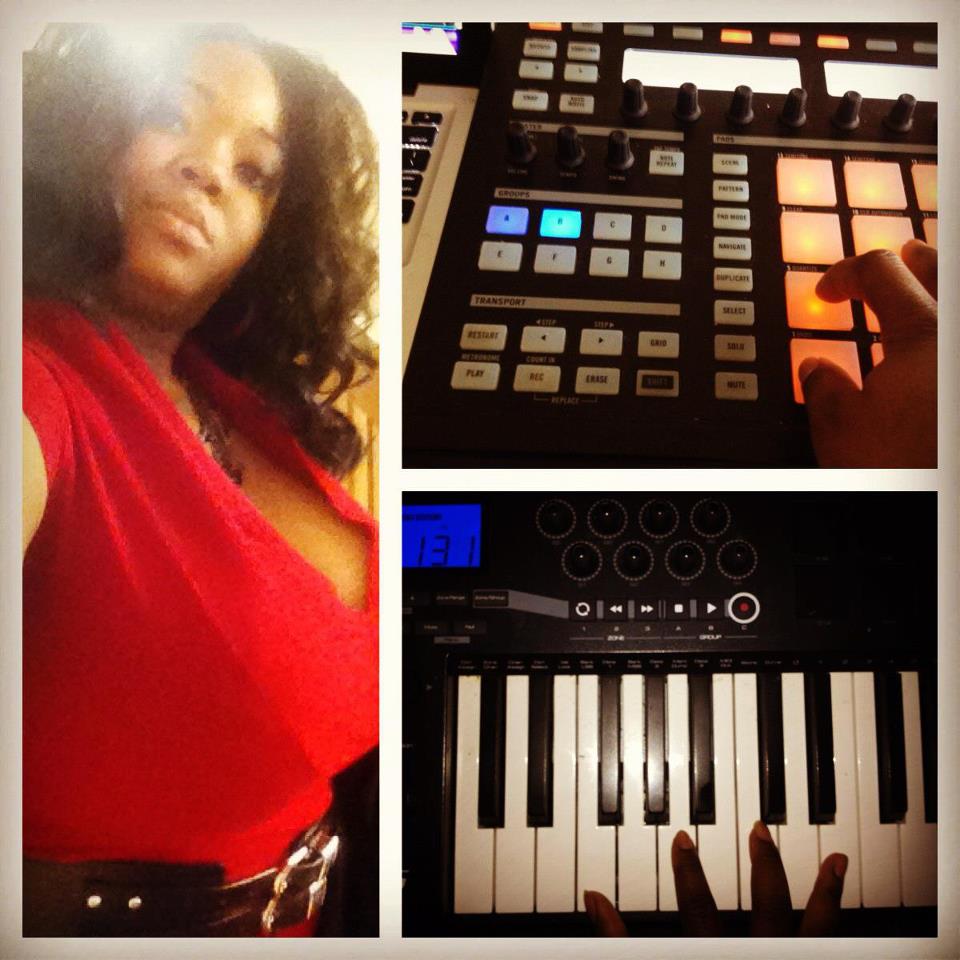
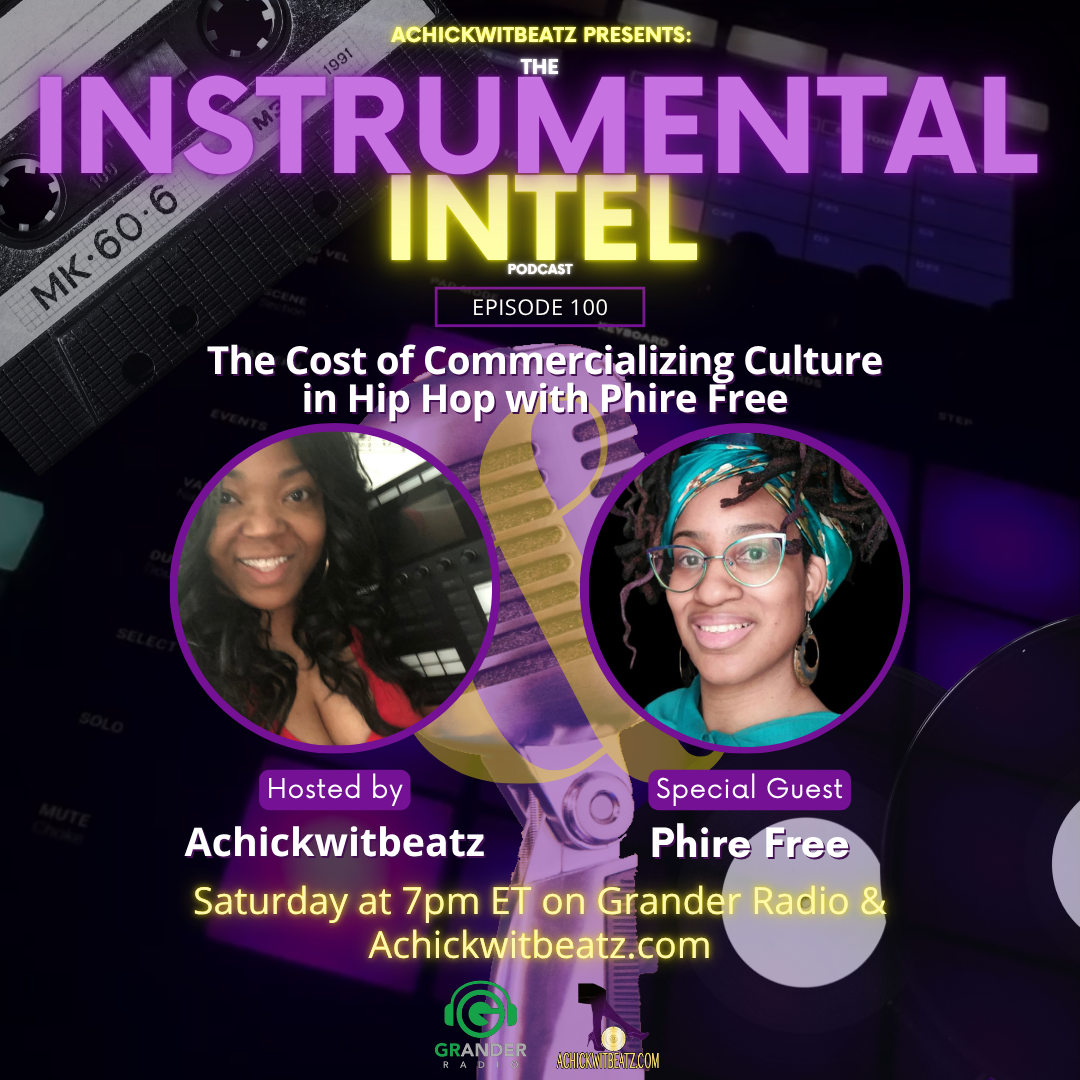
Achickwitbeatz presents the Instrumental Intel podcast, bringing you information instrumental to your artistic career including music industry news & tips, insights & interviews, and beats for your inspiration. Listen on Saturdays at 7 pm EST on Grander Radio and Achickwitbeatz.com.
Follow on Facebook, Instagram, Twitter, YouTube Audiomack & SoundCloud, and subscribe on your favorite podcast platform. Download the Grander Media app to listen to Grander Radio on the go.


- Art
- Independent Labels
- Internet Radio
- Music Documentaries
- Album Reviews
- Music History
- Music Industry News
- Free Game Friday
- Free Downloads
- Poetry
- Books
- Interviews
- Did You See It?!
- Hip Hop History
- Hear Here
- Music News
- Hip Hop Documentaries
- Music Marvels Radio Show
- Think Piece Thursday
- Mini Documentaries
- Instrumental Intel
- Music Humor
- Indie Analysis
- Conversations & Quotables
- Music
- Resources for Artists
- Podcasts
- Beats/Instrumentals
- Music Education
00:00
Hey, thank you so much for tuning in to Instrumental Intel. I am your host, music producer, Achickwitbeatz, and I'm glad that you're here with me. Today's episode is special. It is the 100th episode of Instrumental Intel. Can't believe it's been that many, but I'm excited to be bringing this episode to you. It's got music industry news, instrumentals by me for your inspiration, and later I'll be joined by Phire Free, who was my very first guest on the first episode. So it's going to be a great time.
00:30
And before I go ahead and drop that first beat, I gotta give a shout out to my home station, Grander Radio out of Grand Rapids, Michigan. And with that, let's go. oh
[BEAT BREAK]
12:24
All right, I'm music producer Achickwitbeatz, back with the music biz brief as promised. First up, the dispute between Chance the Rapper and his former manager, Pat the Manager, focused on a $3.8 million claim that was tied to unpaid work and a disputed sunset clause that would have given the manager 15 % of the net profits on all revenues generated by CTR, Cool Pop Merch, and CTR Tourie. Testimony highlighted operational issues like 24,000 unfulfilled merch orders in 2019.
12:54
and allegations that the manager sought Equity and Chances Recordings through United Masters without clearly communicating it, raising concerns about transparency, contract clarity, and manager accountability. So, the lesson to be learned, make sure you get it in writing. No matter how close you are at the time of everything going down, stuff can always go south. Native Instruments has officially entered formal insolvency.
13:20
CEO Nick Williams says the company is looking for new shareholders and has already seen interest from several audio and tech buyers, hinting at a potential sale. All software, platforms, and customer support remain fully operational, and Williams thanked artists, partners, and the community for their ongoing support. At this present moment, this is all the information that I have regarding this. I know quite a few people have reached out on LinkedIn with more questions, and I'll be sure to fill you in as I get answers.
13:48
The US Supreme Court unanimously ruled in favor of Cox Communications, limiting when internet providers can be held liable for music piracy on their networks, or returning the previous ruling that was tied to the $1 billion case brought by Sony Music Entertainment. The court said that just providing internet service, even with the knowledge it could be used for infringement, doesn't make a company directly liable, which could reshape how piracy enforcement is handled at the internet service provider level in the future.
14:17
We'll have to see what happens with this. Apple Music is expanding into concert discovery through a new partnership with Ticketmaster, letting users find nearby shows based on their listening habits and buy tickets directly within the app. The integration adds concert listings across artist pages, a dedicated event section, and notifications for upcoming shows, while also bringing in data from Bandsintown as part of a broader plan to compete with platforms like Spotify, which has rolled out similar ticketing integrations already.
14:46
Queue-it launched a new “visitor engagement” feature that lets ticketing companies collect fan data during high-demand sales by adding interactive polls, quizzes, and email signups directly into virtual waiting rooms. Early tests across over 2 million interactions showed strong engagement and high completion rates, just kind of showing how capturing zero-party data in real time while fans are actively trying to buy tickets can be more effective than the typical post-event surveys. Something to keep in mind.
15:14
And finally, Spotify is testing a new Artist Profile Protection feature that lets artists approve releases before they go live, aiming to stop fake AI-generated or misattributed tracks from appearing on their profiles. Currently in beta, the tool adds a manual review step, but also includes a “artist key” system to streamline approval's kind of balanced protection with the increased workload that this could create for independent artists and small teams, which is actually kind of thoughtful.
15:42
Alright, that's a wrap for the Music Biz Brief, gonna take a quick pause for the cause, and then I'll be back right after this with my special guest, Phire Free. Keep it locked!
[BEAT BREAK]
23:37
Hey, I'm Achickwitbeatz, multi-genre music producer and strategist to indie artists and labels. Visit achickwitbeatz.com for resources for artists and instrumentals in various genres available for songs, vlogs, blogs, podcasts, themes, TV, film, commercials, and more. Once again, that's achickwitbeatz.com. That's A-C-H-I-C-K-W-I-T-B-E-A-T-Z.com. Let's make something happen.
24:07
Hey, thank you so much for tuning in to Instrumental Intel. I'm your host, music producer, Achickwitbeatz, and I'm thrilled to say that I have in the virtual building with me Phire Free, who just happened to be my first guest on the very first episode. And so I'm so delighted that willing to come back for episode 100. Hey! And close out Women's History Month. So yeah, you know, take a moment to... so much. Yeah, thank you.
24:36
for taking the time out to come back. But yeah, if you could just kind of introduce yourself, let the people know who you are and the very many, many, many hats that you wear. Thank you so much for just allowing me to be in your presence. I uh am so grateful. And to be honest, I'm just gracious as we watch.
25:02
you know, as we're watching all the things that we're watching to be able to be here and to have the wisdom and the knowledge. I am an author and a poet, which is actually how we met doing, doing shows together on the road together. Yes. Doing the work and coming to the people. And then I'm also, going to go ahead and say I've, the years I've transitioned into a mother.
25:32
And in that process, I've had to really align into my divine feminine and the femininity of how life has allowed me to grow. And I'm also a mental wellness and health professional with a certification in sexual assault, uh with an understanding of all of the different challenges and things that impact people.
26:01
around the world. so with this coming month of April and this leaving month of March, we're going into Black Women's History Month, National Poetry Month, and Sexual Assault Awareness. So this is kind of my time to attune and align into the universe for this period, which I'm excited about. Awesome. Yeah, a lot of those things that you mentioned.
26:30
have a lot of, I guess, crossover in the music industry. know, mental health, sexual assault, like all these things are things that, you know, they do these surveys every year, every year to see how things are going and the statistics stay relatively the same. So it's like, great that we have this information, but you know, the fact that these are all issues that women in the industry deal with is just...
26:59
Yeah, so I mean it's great that you're taking the time to help people in those facets. you. It's so important. It's actually, really, I am not great, I'm not grateful that all of these things are happening, but I am grateful that people are, that the, you know, the lid is kind of coming off and everybody's looking and saying what's actually happening.
27:24
And I hope that as we continue to have these conversations, we also continue to do the work and continue to allow these voices that are now able to be heard, that are no longer drowned out by masculine toxicity, that we actually allow people to not just be heard, but we actually start taking the time to construct
27:51
some of those safety measures to uphold some of that brilliance. I can tell you the last two years have been absolutely eye-opening for me ah in so many ways and it continues to happen. uh and especially around recognizing and holding space for safety and even having to do a lot of the work myself on myself and decolonizing how unsafe
28:22
the world really has become to femininity. I was actually just writing about it. So yeah, those are all things that I am excited to kind of, you know, discuss and address today. Okay. uh Well, since you brought that up and how you're excited to discuss it, one way that I can kind of uh have a question regarding some of the revelations that you've received.
28:51
But have you noticed a lot of times there would be things that kind of go on, like especially with women in Hip Hop, to where sometimes they'd pit one era against another or, you know, some style against another, like, oh yeah, I miss when women could rap with their clothes on or, you know, it sounds something like where a lot of people think, oh, you know, I'm just telling women, you know, they're beautiful as is, da, da, da, da.
29:18
But you never hear that same thing for, you know, the male rappers without the shirt. Yeah, exactly. Not at all. With the exception of MF DOOM, you know, shout out to him, RIP with, you know, he did kind of poke fun at that. Um, you know, but for the most part, you never hear about that unless it's women. And it's like, what, do you think the need is to kind of, I don't know, I guess, pressure women to conform to one ideal over another.
29:46
It's a brilliant, that's a brilliant question and it's a strategy. it's, um, it's so the, the power and the strength of colonization, cause we, we've all watched how oh Hip Hop became co-opted and absorbed into colonization and they turned it into this big capital tool for capital. And so what we're watching now, especially when we see the women being used as attack dogs, and I know that that may not be the best way to put it, but.
30:13
uh Is divide and rule and it's a way that we watch the the feminine? Into the feminine strength of the power of women kind of get pushed against each other And what it is is it's a binary right? Like if your clothes are off, then you're bad But wait a minute of my clothes are on that I'm good and at the end of the day, there's no winning, right? It's it's how it's how the the rappers
30:40
and how the artists are able to express themselves really. Because remember fashion is one of the elements of Hip Hop. Like why are we allowing people to tell us what it needs to look like? Yeah, that's a great point. Yeah, it's just something that I see it a little bit less these days, but I don't know if it's because there are fewer people doing it or if I've fine tuned it out of my algorithms.
31:09
I mean, it's probably a combination of both because one of the things that happens is once we get hit to something and we're like, wait a minute, this is the most garbage conversation, like why are we doing this? Then they have to switch up tactics. And so one of the biggest ones right now is, you know, support black women. And it's just it's just the weaponization of the black femme identity that in every aspect. And it's desperate. So we're seeing it in like
31:37
support black women and like, at this particular point, what we ultimately have to say is like, we have to support our vulnerable communities. We have to support because we're not, are we saying that about our disabled communities? Are we saying that about people, our black women that are not able to be seen as clearly because they have mobility issues or are not heard as clearly because they have, you know, they have
32:05
um verbal issues or because they have issues being they have you know audible um issues hearing um impairments excuse me because they have hearing impairments and so it's like we're not asking ourselves those critical questions and so when we start seeing that and i love the fact that you asked about this because that means that your initial response is like why is this so hostile like this shouldn't be a hostile space right this is love peace and you know
32:35
a connection with each other in having a good time and building our joy together. Like there should be no reason why we should be going, well, why is she not wearing any clothes or why is she wearing those shoes or girl, you know, you can't like we shouldn't be tearing each other down when we're supposed to be lifting each other up. Right. oh Yeah. Thank you so much for for saying that. And, you know, just
33:03
even what you were saying about the different communities within communities and how important it is to make sure that people aren't overlooked. mean, I think that that's something that is important to be in so many aspects just of life. um to find the right words and how I'm trying to say this. Like, I feel like some of the importance of music when people find, especially
33:32
people who do niche genres or, you know, styles or whatever the case may be. When people connect with that, it's because maybe they find that, you know, they feel that they're unique in this aspect. But once they get to know an artist, like, hey, you're telling my story, I can relate to this. So it's something that I feel like music kind of does inherently. But yeah, you don't really see it. And that's typically why music is considered an escape because our world doesn't really reflect that type of inclusion.
34:03
Yes. It's a complex thought, but I'm trying to break it down a little simply to where it still actually makes sense. I hope it does. But well, you, you did that beautifully because I think that's something that we miss because so many people are chasing the colonized shiny, sexy version of everything that when you really start talking about like the rugged, rough, um, gritty,
34:31
parts of life that are not colonized, but the real, you know, elbow grease and work side of life, oh we don't, we're not immediately attuned into that. We're not immediately going like, oh, let me look over there. And a lot of people are going, how did we lose, you know, our connection so deeply? Oh my goodness. I see. It took me to another place.
35:00
One of the things that's going on is everybody has been judging black people for saying like, oh, come off the cookout or for being excited when people have rhythm. But one of the things that we forget is that a lot of our conversations were through drums and music and rhythm. So when a person can speak that language, it shows the ability to trans
35:27
to transform outside of, know, I speak colonizer English, you know? And so when that speaks to us, when we celebrate it, it's not because you can snap your fingers on beat, it's because you have the ability to speak another language. You have the ability to connect with me in ways that I have, that trans, you know, that are interconnected outside of, you know, a flat,
35:56
I'm gonna say a demonized version of life that we've all been forced to force-fed for years decades Wow I've never thought about it like that. That's a very interesting point. I appreciate talking to you Yeah, yeah, that's a really great point um Okay, so with that being said when you had mentioned
36:26
about how things came in. We were talking specifically about uh fashion, about the colonization of Hip Hop and basically, you know, trying to make sure that it got monetized to almost every aspect that it possibly could. ah How can I say this? There was a certain era where you began to see that happen. However, I kind of feel like even in present day, it kind of has a snowball effect.
36:57
As soon as you said it, kind of made me think about Nikki and it was Nikki and Lil' Kim, right, for a little bit? Yeah. Then they tried to pit her, then they hit Nikki against everybody and now Nikki is full on just anti-Hip Hop altogether. Yeah, like she was definitely a tool and then they had, I think they did Nikki and Megan. Yep.
37:26
And then they did the most recent one was Nikki. It wasn't most recent, but it was like Nikki and I can't think of her name. There was Cardi. Cardi B. Yep. There was somebody else in the mix too. Oh, of course, Remy. um That was Remy. Yeah. uh
37:45
Um, and I still feel like I'm kind of missing someone else in there too. Cause I think they had her not sexy red, but they had her also pitted against somebody else. Like they put her against the new generation, the older generation. They had, they pit Nikki and Nikki is, isn't Nikki technically our gender? don't know, but she is. That's what's so funny about that. Yeah. So like they pit, basically use Nikki to be, I don't know, like they, think they were trying to make her like Madonna.
38:15
But like, yeah, like it's just, it's not the same. Hip Hop doesn't respond the same as like mainstream. Can you break that down a little bit? I think I was trying to think of somebody that would have had a similar, you know, caddy background, but like Madonna kind of had a bad girl reputation.
38:41
commercially mainstream, no matter where you went. If people about there was that period in the 90s when her tour was like the hottest tour in the world. and so they everybody had everybody had something to say about Madonna and a lot of it was bad And so if you think about Nikki, who has never been able they've never been able to get her packaged and marketed that intently.
39:05
Um, they tried to pit her as like this bad girl of Hip Hop. And then I think they were trying to get her into the beasts to see if, know, her beef would do what her beef against Remy Ma did. And it just never did. Cause everybody already knows like Nikki was a mess. She was, she was kind of like, I kind of believe that the community was supportive of her and like, uh, you know, we're going to, um,
39:34
empathize and humanize you type of way. And they didn't understand that that's what was happening until, you know, Nikki's humanity has been completely disproven. And now it's just like, she ain't it. Well, okay. You talk about the packaging and man, I'm trying to find the best tactful
40:04
politically correct way to say this. But in reality, when she was presented, like, so you see the older videos from before she got famous and saw like the type of style she was on. But then once she was actually packaged and, you know, kind of placed out to the world, she was the culmination of all the female rappers that came before her. Had she been younger doing this, it probably would have just been seen as
40:32
I don't know, maybe she didn't know, but to be of the same age group in bracket. So, you know, all the different styles that you've borrowed from and you're not actually paying homage. You just piecemeal in it and putting it together and pretending like you created something new. And I feel like that might be why some of that support kind of started waning initially for some people, you know, but like for me, it's like, okay, well.
41:01
You know, you're doing voices like this, you're dressing like her, you know, like I can see all the similarities in the whole pink thing. Lil' Kim was calling herself a Barbie long before she got on the scene. gives us old enough to know that. But to pretend like, oh no, you're just trippin', like you know who styled you a bit. Like I said, had she been younger, fine. You could claim ignorance, but yeah, like no, you're literally old enough to know that.
41:28
Well, okay, so not to because I'm not defending her but they did the same thing with Beyonce, right? Like they literally took Beyonce and they pieced all of these stolen styles together and they couldn't get that off the ground either. But the difference between Nicki and Beyonce was Beyonce like I see. All right. I'm gonna say some stuff. uh
41:55
You're gonna have all the hives and everybody on us, but the barbs. uh Yes, please. but so basically in order for Beyonce's career to be launched, they basically pulled Neo Soul out. We lost, we stopped seeing and it became less, it became more difficult to see and find Jill Scott, Erykah Badu, and India Arie.
42:24
All of Amel, all of the the Neosoul, calm artists. They also one of things they did was they slowly started slow cycling. So we lost Britney Spears. I don't know if anybody understands how intense it was when they were trying to force Beyonce down everybody's throats. But we lost Britney Spears, not that I liked her to begin with, but they they basically put her her whole career through that.
42:52
ridiculous cycle that she can't get out of even now. And they replaced her with Beyonce. And then they started slow cycling and slowly pulling out all the white pop stars. So we weren't seeing Jessica Simpson or oh gosh, or Mandy Moore or Kylie Minogue or any of those artists as simply or as easily as we were.
43:19
before they decided to just, we're gonna hyper commercialize Beyonce. And then it began to the point where you couldn't look up without saying Beyonce. And if you wanted to launch an artist, they had to have a Beyonce track like Lady Gaga, which that never should have happened. So.
43:44
If you look back on that era of time, was so much, that's when music really became noise and like it became sifting through garbage to try to find your niche really, because it was all so bad. So if we think about what music had to become to build a Beyonce superstar and to
44:12
take Michael Jackson like out of the out of the rotation, they did a lot of work. so in order and they had to in a way they kind of lost Hip Hop, which was their main, you know, source of like manufacturing and one of their biggest prize possessions, because they did so much to take it out of the hands of the people that when we look and it's like when you look
44:40
back on it in retrospect, it's like, oh my God, like that was an entire just dismantling of one of the most beautiful systems that people have built. And out of it, we get like Beyonce and Nicki Minaj and a bunch of artists that do not have the same vocals that they had, you know, prior to the early 2000s. Hmm. Yeah. And everything that you just said, I mean,
45:09
You you raised some great points and all this was also happening around the time that all the labels were buying up the blogs. So you were losing the blogosphere where you could still kind of find your niche stuff. Like, yeah, all that stuff was was very, very coordinated. The amount of money that they poured into we're going to have a Beyonce superstar is like it's like AI, you know, like if that
45:38
Then and that plan did not succeed. It kind of failed. But out of that, you know, they had to get something which I mean, they pulled Janet Jackson out of the Super Bowl. Like I say, I can come from this side, but yes, like to watch the niche market, the smaller Hip Hop writing markets just immediately just.
46:05
flip into everything Beyonce and everything, you know, similar to the sound and the praising. And I'm not, this is, I appreciate and respect Solange, but down to praising Solange who had a number of scandals before, you know, 2000. Yeah. I was like, I was going to say something about that, but then I was like, perhaps I should.
46:35
I understand. But yeah, I mean, you, raised some very valid points. Um, even right before it was well known that some of those smaller blogs were getting snapped up. Um, once you kind of look back on the track record of the people that they were starting to highlight right around that time, those are some of the same people that were accused of being, uh, industry plants.
47:05
Yes. So, yeah. come out? I think some of them it has come out, right? Well, I mean, you know, it's always disputed. Oh, yeah, you can you can look at the facts and kind of make your own conclusion. And in my opinion, yes, it's already come out. We all know. Of course, they just say, oh, no, I'm not an industry plant. And then, you know.
47:30
It just doesn't get brought up again until you're arguing with somebody in the comments on some video that's even, you know, just mildly or slightly adjacent to what the original topic was. But yeah, the machine has been a very interesting thing to witness. So yeah, mean, it's just snowballed and you just gave examples to actually confirm what I was thinking.
48:00
Yeah. You know what? Oh, go ahead. Go ahead. Yeah. I mean, I just think about even from, you know, when I was a kid with Yo! MTV Raps and Rap City, mean, there was so many different options, so many different ways to get so much variety. And then to just see it kind of chipped away year after year after year until we are where we are now. I mean, and, to
48:29
And then when they decided to try to expand a little bit, because you I don't know if you kept up with with the sisters, Chloe, the Bailey sisters, but like Chloe was is they're both Beyonce's artists. And so they were talking about how Beyonce derailed Chloe's album, ah which she did. Yeah, she did a remarkable job.
48:57
promoting and creating a following for her album. And then they tried to say that it was because she depended so much on social media. And it was like social media was carrying Chloe that entire time. But what happened was uh Chloe was supposed to release a song and ask the audience what they wanted. And I guess at the last minute, Beyonce told her to release another song. And
49:26
Yeah, and then Chloe was like, you know, when the Queen tells you so on and so forth, you know, and of course, you know, there's nothing wrong with with respecting the person that is, you know, supporting your career. But at the same time, it was like,
49:43
You know that for me, Clink made everything clink because I'm like, oh wow, like Beyonce being being made, you know, the the fire engine stoop superstar that she's been made through the machine. Still, after 20 years, still can't handle having another vocalist with talent in her and like, you know, around her. Like I this is why it's wild. Like what ego.
50:12
was built like at some point, know, you can always walk and say, I'm responsible for, know, for this music. And even within that moment, she just, she couldn't, you know what I mean? Like, how are you spreading? Fat Joe's been doing that riding that wave for years. yeah, I'm pretty sure that's the only like 90 % of the reason why he gets the coast on most of the stuff he gets the coast is just because they're like,
50:41
Yeah, everybody's like, thank you for big pun. What that's like, because thank you for big pun. We are a very forgiving community. Oh, my gosh. I'm still trying to figure out how Rick Ross is still happening. I don't know. When do we allow this? yeah, I don't know. I'm wondering the same about Drake, too. And I know, like, we should be mad at Lil Wayne.
51:09
low seriously, but you know, he's still just able to do what he does. Sorry. Hey, Hip Hop culture. These conversations are a part of it. Culture commentary is necessary. Cause I mean, look at what happens when it goes unchecked. We get the people that we've just mentioned. And that's another thing.
51:39
Oh man, because we got a gatekeep. Like we now officially have to gatekeep. I've been getting into, one of the things I do want to work with the youth with is STEP and utilizing STEP and understanding STEP as communication. And it's really sad because a lot of STEP is aligned and thought of as something that the fraternities and sororities do, which they do.
52:08
But it's almost like the whole rich history, the wealth of knowledge that goes with it is lost. The power of communication, the strength of being able to connect and to be able to create the conversation around what is going on and the happenings and ways to respond. And so I'm really getting saddened by the fact that like, for one thing, the one thing that
52:39
is held within the Hip Hop community is femininity and the strength of femininity and the strength and the love of rhythm and the communication through rhythm and all of the things that come you know from the culture of being able to hold to that communication and so I am
53:04
Like I think that it's important for us to understand like gatekeeping and not allowing just everybody to be able to Come in to doors that have been closed for a reason Hmm I think that that's very interesting point. I know one of my pet peeves I guess more so within the last few years is the difference between
53:34
Hip Hop as a culture and rap. And I feel like more and more people are starting to kind of not really understand that there can be a difference. It's not always a difference, but there can be a difference. And I feel like we need to be a little bit clearer and actually kind of, you know, start holding more people accountable when it's misused that way. Absolutely.
54:01
There, you know, one of the things I love about the generation before us, and I know there's a lot of things we can say about Gen X, so many, they did. Right, right, like y'all. But they did make sure that we understood that there was a culture and then there was like the products and the package and we needed to separate the two. Yes, you can be.
54:29
You're welcome to come in and understand the culture, but don't just take our culture and package it and call yourself a product, like, in which we've allowed to happen too much. But we, we got to, we got to lock that down because it's at this point, you know, understanding the culture isn't just, you know, some terms and words.
54:54
It's understanding, you know, the struggle. Like Hip Hop was born out of one of the most, one of the realest struggles. And that struggle hasn't ended. Right. Yeah. So it's like the music's for everyone, but the culture isn't. Right. There's a difference there, but yeah. Right. And the culture is created to help people understand that like we need you to see us.
55:22
But you can't just see the shiny things and the spectacle and go, oh my gosh, that's so cool. You kind of have to see that there are people who are creating all of the shine, all of the sheen, all of the glamour, and those people need to be able to live and survive. Yeah. Incredibly well said. Thank you. Yeah. So, okay, like our time, I feel like it always goes so quickly.
55:52
Anytime we get together, but oh I want to make sure that everyone knows where they can find you, follow you, keep up with what you've got going, website, whatever the case may be. Yeah. However you want them to keep up with what you've got going on. Thank you. Yeah. So I am, uh, I'm on Substack at FreePhire. And then there's also, um,
56:21
Fire Free. one is, you know, Substack. don't know if Substack automatically starts you with two, but one is a accumulation of my collection of poems. I'm working on my second collection, uh Commits a Healing, Volume Two Reclamation. And it's two of three volumes. It's originally supposed to be three volumes.
56:48
And originally I was going to talk about the process of growth, but now it's becoming the kind of like a reflection on the people's movements. So that's coming, look out for that. Also, you can find me @FreePhire on IG for now. And I'm @FreePhire on Upscrolled, and I'm @FreePhire on Mastodon. It's at FreePhire.
57:17
And then FreePhire.com is my website where I do talk about my workbook to bring into mindfulness and presence. Presence and awareness is the appropriate way to phrase that. All right. Awesome. Well, you know, maybe I can have you come back in time for May. Oh, would love to. I would love to.
57:42
Also, um, I do want to ask you, so I know that you've been really busy and got things going. We, how, what's, what's, how are your projects coming? Oh, um, well, pretty well. I just released your mother's beats volume one through Nylon tracks. this is, uh, something new because typically I've only released house music through Nylon Trax, but.
58:11
Um, shout out to Jaymz Nylon for having the vision and, um, yeah, he approached me with the idea, uh, title as well about black women being the cradle hood, know, the cradle of creation. And, um, so yeah, like the play on words and what it means and then the homage to, uh, old school vinyl instrumentals and all that good stuff. yeah, I'm very excited.
58:39
This is the first time I've ever been a part of something like this. And so for him to put the nylon tracks machine behind me has been very special. Thank you for asking about that. And also shout out to UltraMag7, who works very closely with Chuck D and recently had a feature in the Rap Central Station Mag, the second issue. He shouted out me and Instrumental Intel. And so, you know, was a good look for the podcast.
59:08
Much appreciative for both UltraMag7 and Jaymz Nylon of Nylon Trax. That's so dope. Congratulations. Thank you. Great. So yeah, once again, appreciate you for coming on. Everybody check them out everywhere mentioned and yeah, thank you. Happy back soon. Yes, definitely.
59:30
Alright, that's a wrap for this episode of Instrumental Intel. I've been your host, music producer Achickwitbeatz. Once again, I'd like to thank my special guest Phire Free for coming through with thought-provoking conversation, experience, and gems. I'd like to thank you for tuning in, and of course, I'd like to thank my home station, Grander Radio out of Grand Rapids, Michigan. Make sure you come back next week. I got more goodness lined up for you. So, until next time, you know where to find me. Tune in, tell a friend, and I'll see you then. Peace.


![Hear Here: Achickwitbeatz - Dopamine & Serotonin [Single]](https://images.squarespace-cdn.com/content/v1/52b0b90ae4b0293bfed0d692/1710852808557-EZYGFDIBHLBSIRFOVS1Q/Dopamine+%26+Serotonin.JPG)





![Hear Here: Dagga Man- "Analytics" [Prod. by Achickwitbeatz]](https://images.squarespace-cdn.com/content/v1/52b0b90ae4b0293bfed0d692/1584638158548-9R55AZLWZIDFJC8LATV6/IMG_2212.JPG)







![Making Music on a Budget [Infographic]](https://images.squarespace-cdn.com/content/v1/52b0b90ae4b0293bfed0d692/1582844361438-3JTE5NT3EL51FHXC0WJI/making-music-on_1929722%25281%2529.jpg)

A homage to the golden era of 1990s instrumental beat vinyl. Crafted as the perfect partner for freestyling MCs, dancers, and DJ culture. | Visit Achickwitbeatz.com for your instrumental needs & dope stuff for music lovers.