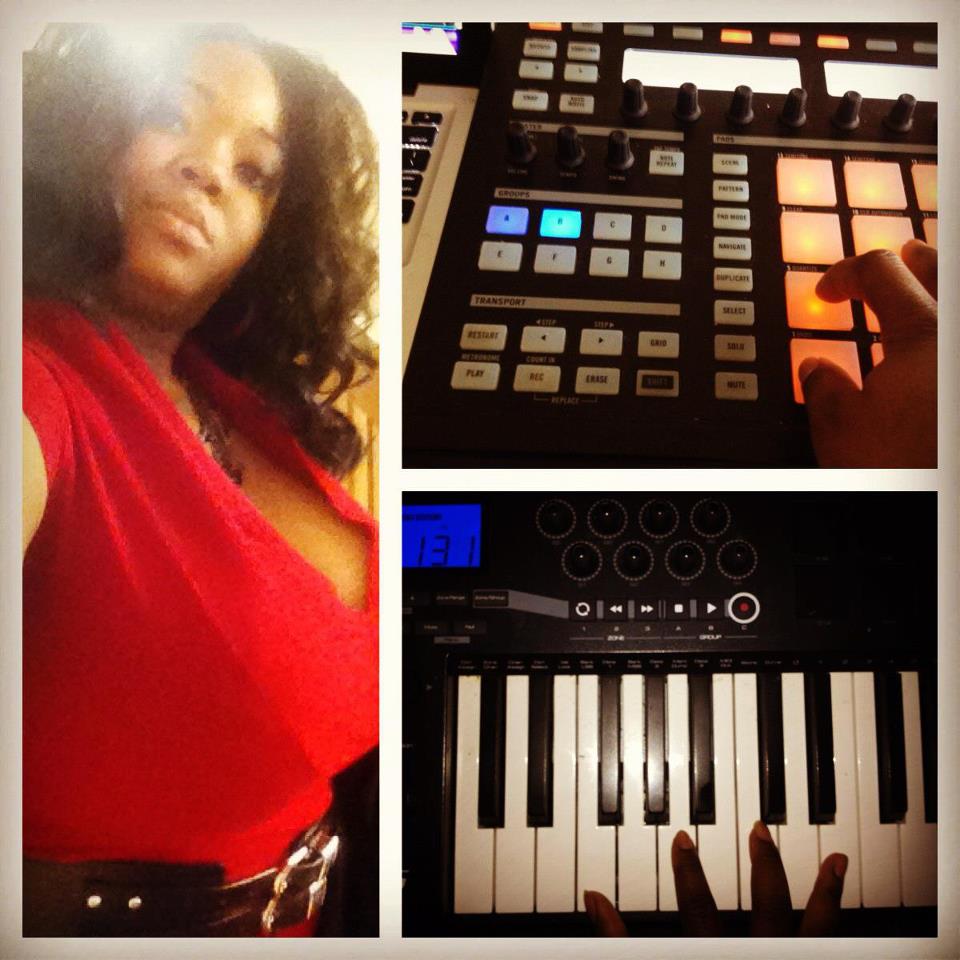
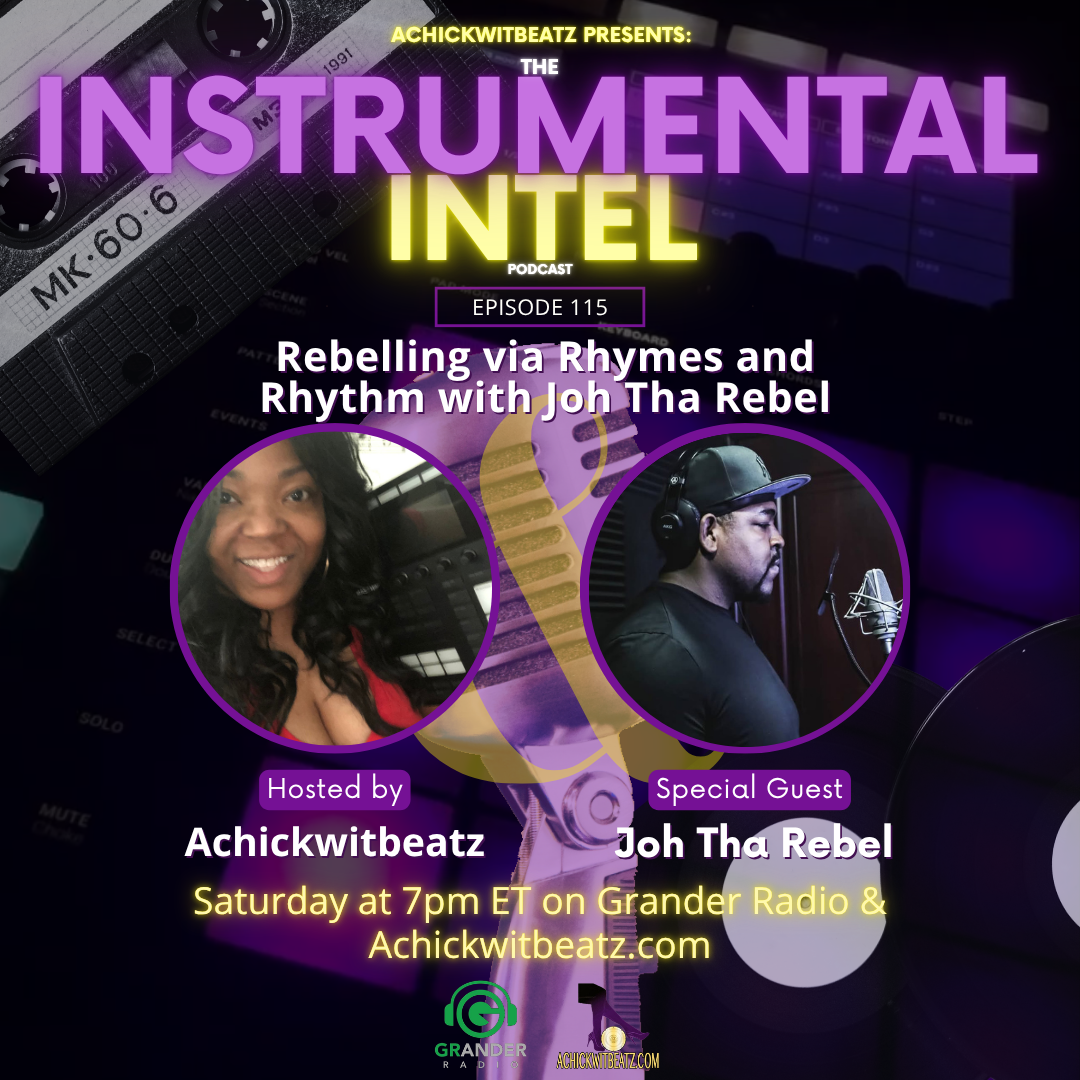
Achickwitbeatz presents the Instrumental Intel podcast, bringing you information instrumental to your artistic career including music industry news & tips, insights & interviews, and beats for your inspiration. Listen on Saturdays at 7 pm EST on Grander Radio and Achickwitbeatz.com.
Follow on Facebook, Instagram, Twitter, YouTube Audiomack & SoundCloud, and subscribe on your favorite podcast platform. Download the Grander Media app to listen to Grander Radio on the go.


- Art
- Independent Labels
- Internet Radio
- Music Documentaries
- Album Reviews
- Music History
- Music Industry News
- Free Game Friday
- Free Downloads
- Poetry
- Books
- Interviews
- Did You See It?!
- Hip Hop History
- Hear Here
- Music News
- Hip Hop Documentaries
- Music Marvels Radio Show
- Think Piece Thursday
- Mini Documentaries
- Instrumental Intel
- Music Humor
- Indie Analysis
- Conversations & Quotables
- Music
- Resources for Artists
- Podcasts
- Beats/Instrumentals
- Music Education
00:00
Hey, thank you so much for tuning into Instrumental Intel. I'm your host, music producer Achickwitbeatz, and I'm glad that you're here with me. Today's episode has music industry news, beats by me for your inspiration, and later I'll be joined by my special guest, Jo the Rebel. And of course, we're going to talk about rebelling via rhymes and rhythm and so much more. So I'm excited to be bringing this episode to you. And before I go ahead and drop that first beat, I've got to give a shout-out to my home station, Grander Radio out of Grand Rapids, Michigan…and with that,
00:29
let's go!
[BEAT BREAK]
11:25
Hey, I'm Achickwitbeatz, multi-genre music producer and strategist to indie artists and labels. Visit achickwitbeatz.com for resources for artists and instrumentals in various genres available for songs, vlogs, blogs, podcasts, themes, TV, film, commercials, and more.
11:55
Once again, that's achickwitbeatz.com. That's A-C-H-I-C-K-W-I-T-B-E-A-T-Z.com. Let's make something happen. Hey, Achickwitbeatz back with the Music Biz Brief. First up, Spotify removed 500,000 suspected fraudulent streams from Malcolm Todd's song, Earrings, seemingly connected to Kalshi prediction market bets. Music predictions on Kalshi have already hit $400 million this year.
12:24
Users can wager money on things like the most-streamed song on Spotify in a specific month, potentially tempting them to try to tip the scales in their favor. The track stream spiked 70% in one day, pushing it to number one on the Daily US chart for the first time. A Kalshi trader alerted Spotify to the activity, and after the questionable streams were removed, the song dropped back to number four. Kalshi had already paid the bettors based on the erroneous stats before the fraud was confirmed.
12:53
The artist and his team aren't suspected of being involved. Spotify intends to add more checks prior to publishing charts and has also requested the removal of its logo from the Kalshi and Polymarket websites, so it doesn't appear to be in partnership with either company. DistroKid, the independent music distributor of 30-40% of new music globally, is selling a majority stake to CVC Capital Partners. Managing roughly €209 billion in assets,
13:21
CVC's entertainment investments include music festival operator Superstruck, theater production company Stage Entertainment, and Formula One. Insight Partners, the firm that recently acquired German distributor Zebralution, will retain its significant minority stake in DistroKid, and the deal is expected to close in Q3 of this year. Fan data platform Openstage and music data company Vibrate have launched model context protocols, better known as MCP servers,
13:49
to enable users to connect platform data to AI services such as Claude, ChatGPT, and Gemini. Openstage says artists and their teams can ask questions like who the most engaged fans are who haven't bought anything and what they have in common, where the top fans are located and how to gain more, and request a time-based audience growth plan. Vibrate statistics on over 100 million songs, 11 million artists, and 19 million playlists can be queried via AI to receive lineup suggestions.
14:19
marketing strategies and artist predictions. Jermaine Dupri is suing Sony Music Entertainment for $18 million in unpaid royalties dating back to May 1992, when his So So Def Entertainment signed with the company. The filing accuses Sony of underpaying royalties and retroactively changing statements impacting multiple So So Def royalty accounts, including Mariah Carey, Usher, Bonecrusher, Bow Wow, Debrat, Xscape, and more.
14:47
So it'll be interesting to see how this turns out. Catalog valuation tool ValuePunks offers artists and labels a free report for one catalog, analyzing data across streaming, physical, sync, direct-to-consumer, and neighboring rights. Launched by Swiss tech company Tribe Music Group, the tool is a freemium service with paid tiers for labels and enterprises designed to help those below the iconic level understand their valuations and maximize earnings potential.
15:16
A US federal judge ruled that a jury should decide if the dembow rhythm (Dem Bow Riddim) used in reggaeton was created by Steely and Clevey in their 1989 Fish Market song, in a copyright lawsuit naming Bad Bunny, Pitbull, Drake, Justin Bieber, Daddy Yankee, and over 150 artists spanning roughly 2,000 songs, the judge felt both sides built directly conflicting cases, making the jury trial necessary unless a settlement is reached. So this will be another interesting one to pay attention to.
15:46
Indian ticketing platform thumpN has launched in beta. It prompts users to rank multiple categories of interests, including sports, comedy, music genres, etc., so that its AI agent called Shadow learns your tastes over time. Instead of traditional search, fans can use natural language to ask Shadow to find ticketed events they may be interested in attending. The company is also building tools to provide event organizers with insight into audience preferences, event demand, genre trends,
16:16
and consumer behavior, which will be bundled into its ticketing commission model. Irish ticketing company Tickets.ie collapsed last month due to two key clients exiting and bad forecasting. It closed after a weekend when three festivals that used its service took place, and now all three events are collectively owed 600,000 euros and are calling for Irish politicians to tighten regulation of the ticketing sector.
16:40
Live entertainment company DEAG bailed the platform out after it had COVID-related money troubles in 2022, which included a commitment to underwrite any shortfall in customers' funds that expired in October 2025. The loss of its two key clients, one being promoter Singular Artists, which happens to be majority-owned by DEAG's KMJ, and the second being the Taste of Dublin Festival, added to its cash flow problems. Then,
17:06
The company's incorrect assumption that 25% of ticket sales needed to be paid in the short term and 75% in the long term just amplified its cash flow complication. So hopefully those owed money can get taken care of when the whole liquidation process is taken care of. And finally, Primary Wave's $1.5 billion purchase of Kobalt is official.
17:31
So it includes its global operations, copyrights catalog, and digital collection society, Amra. Kobalt will continue functioning as a standalone company led by its current CEO and management team. Alright, and that's a wrap for this week's Music Biz Brief. I'm gonna take a quick pause for the cause, and then I'll be back with my special guest, Joh Tha Rebel, right after this. Keep it locked!
[BEAT BREAK]
26:10
Hey, I'm Achickwitbeatz, multi-genre music producer and strategist to indie artists and labels. Visit achickwitbeatz.com for resources for artists and instrumentals in various genres available for songs, vlogs, blogs, podcasts, themes, TV, film, commercials, and more. Once again, that's achickwitbeatz.com. That's A-C-H-I-C-K-W-I-T-B-E-A-T-Z.com. Let's make something happen.
26:40
Hey, thank you so much for tuning in to Instrumental Intel. I'm your host, music producer, Achickwitbeatz. And I'm excited to say that I have in the virtual building with me today, Joh the Rebel. Uh, first of all, I want to say thank you for taking time out of your schedule to come and chat. And if you could let the people know a little bit about who you are and how you got started in music.
27:03
Oh, Joh Tha Rebel, the name derives from my foster mother. Used to call me Mojo when I was little. So I just took the Joe out of that. And the rebel part is like, I rebel against anything that people think is trendy. Like everybody, what everybody follows, I don't follow.
27:31
Okay. That's just the whole course of my name and what I represent. Hey, that's what's up. So yeah, how did you begin to get involved in music? At a very early age. I started writing when I was 10. It was right after Biggie passed away. That just...
28:00
I just wanted to get into it, because I liked him so much. He was so phenomenal. And he was doing things at such a young age that I couldn't believe at the time. So I'm like, maybe I should take a crack at this. So I just started writing. Man, it really didn't get any traction until much later.
28:30
Yeah. Okay. I feel like that's true for, you know, most people, even some of the big names. A lot of times the overnight successes actually started a little long time ago. Yeah. was, uh I was, I was terrible when I first started. just, I just kept at it and kept at it like repetition. Yeah. I just got better as time went on.
28:59
Yeah. You know, I personally, I kind of used to feel that way, but now I'm less embarrassed by what I used to call my struggle bars. They help me get to where, you know, like you have to do that. That's the only way to get better is to just keep doing it and plugging away. Yes. Yeah. Okay. So Biggie was part of your inspiration. And that's why I got into this. Yeah. So I know this is probably a difficult question.
29:29
But there's so much to like about Biggie. What is it exactly that kind of drew you in?
29:38
His flow, his wordplay, his swag.
29:46
Like he knew exactly who he was. Like he ain't trying to pretend to be something he wasn't. Like when he said, he said I'm black and ugly as hell. I'm like, oh man. Like, bro. Like, yeah, when I heard that, I'm like, yeah. I I aspire to be like that. Yeah. Especially during a time of, I guess, like braggadocio.
30:16
It's like you weren't really hearing a lot of people just coming straight out. know, it made him feel more authentic to me. Yes. Some of the other stuff that was happening around that time. That's a life after death. One of my favorite albums ever. But that's I have that rotation constantly. That's what I think. Kick in the Door might actually be my favorite primo beat. Maybe.
30:47
I'm kind of stuck on a few, but I think it might be. It's definitely top five, but yeah. Yeah. He has soulbitty though. Yeah. Like if I was to choose one, would be Royce the Five-Nine. Boom. That's my favorite Primo beat ever. Yeah. But man, yeah, not to digress a little bit, but you mentioned life after death and that was the first thing that popped up in my head.
31:15
So, yeah, I mean, as an artist uh with an ear for good beats, how you choose oh what you use.
31:28
I have to feel it in my heart. If it doesn't touch my emotions, can't rock with it. Even if it's a dance track or something sad or a love song, whatever it is, has to touch me emotionally.
31:57
to be able to deal with it. Because the more I'm feeling the beat, the faster I write to it. I'm just like in tune with it. Yeah, that makes sense. It takes more for me to write it usually because I'm not feeling the track. Mm-hmm. Okay, so like in the situation of maybe like featuring, that's the case.
32:21
You know what mean? Like it might be somebody else. They picked it and like, okay, I might not have used this for myself. I can do it, but it's going to take me a minute. Yes. Okay. Gotcha. So can you walk us through like your typical creative process? Like when you're working on something, like what do you kind of do? I mean, once you have that beat that touches your heart, how do you get into it? Just write.
32:45
Uh
32:48
uh I need complete silence first of all. I like to work on.
32:56
You know, people like to people around them all the time. Yeah. I know I have to work by myself. That's the only way I have a clear head and I could process my thoughts clearly to write it down. OK, whatever I'm writing on. And none of those super loud, busy studio sessions where everybody in there. No, I can't do that. Like I just.
33:25
I just turn the beat on, I just rock out. I just get in the zone. I just go wherever the beat takes me. Okay. Makes sense. So, you had mentioned how when you first started, weren't where you are now, of course, but what would you say was that turning point for you?
33:52
to where you're like, okay, I know I need work. But then like, once you realized, all right, now I actually got something here. Can you talk about what that moment was and how you knew that this is what you're supposed to be doing? It wasn't until I was 16. Okay. Yes. It was a song I wrote and I never wrote a song like this in my life. was just like so lyrical and so the wordplay was crazy.
34:23
And the song was called Young Sinister. Young Sinister? Yes. Okay. Horrible name for a song, but yes. Actually, it sounds quite enticing. But when I wrote that song, I'm like, I'm out of here. I wrote three verses, 16 bar verses. I'm like, whew.
34:52
I'm like, I didn't even know I could write this. just came to me. That's why I'm like, I'm, yeah, I got something. I could do this. Okay. Yeah. That makes sense too. Cause yeah. Once you, realize like, okay, my ping game is pretty strong here. That had to be a good feeling. Of course.
35:19
Yeah, so how did you follow up and continue to just grow after that? Because you know, sometimes people hit that pinnacle right there and they just be like, oh, yeah, I'm good. And don't even try to push any further. Like, how do you kind of keep that that mentality going? And I know that you have because, course, I want you to talk about your new single that you got out. But yeah, how do you kind of keep that flowing?
35:46
See, after that, life just started to happen. I hit a slope for real long time. It took me a while to get out there.
36:04
get out of the slope. I wasn't motivated. I wasn't writing any songs. I ain't even want to do music at a certain point. There's just so much stuff happening in my life. But eventually,
36:28
Once things started to get better, it's like, okay, motivation started to come back.
36:36
So yeah, guess once that happened, how were you able to kind of push past that? there's a lot of times when, like you said, life gets life in and people do kind of slow down for a bit, but sometimes they just stay there. So like, you know, once you started feeling that, that pull back to it, like, did you fight a little bit or did you just go ahead and roll with it?
37:01
Off board.
37:04
I fought as much as I could at the time, it was too much at that point in time.
37:15
Like once everything once everything started to subside, that's when it's like, okay.
37:23
I started to get right back into it. Started writing again. Got into producing actually.
37:35
So even with that, were you still producing during that time or uh was you kind of started getting your love for it back once you started producing?
37:49
Well, I didn't start producing until like 2018. Okay. Yeah, that's... Yeah, my friend got me into the producer thing. He taught me everything I know. I had no idea. I dabbled in it before, but I was horrible. He taught me...
38:19
how to really like do things on, I use an MPC. Yeah, we would just, every week, we'd give you lessons like, yo, do this like this, like, yo, this goes here, like, like, this goes there. I'm like, it's pretty easy. Yeah, I feel like a lot of people who
38:49
feel that way, you're kind of intuitively, uh I guess, for lack of a better term, born to produce. Because I've talked to people who probably weren't born to produce, and they do find it quite challenging. And I've even tried to instruct some people before. And depending on where they're at with it, it was either like, OK, I get this, it clicks, or just, no, I'm not hearing any of this. I don't know how to.
39:18
So yeah, the fact that you were one, were willing to learn and dig deeper. The reason why I learn is because, I mean, when I have ideas, don't want to call anybody. I just want to turn the machine on and put those ideas to work. I don't want them to make a call like, I need you to do this for me. no, dog. Let me put this to work.
39:49
That's the main reason, that's the main thing that motivated me to do it. Okay. Yeah, that makes sense too. I got, yeah, totally get that. uh Especially as a producer, when you're on the opposite side of that, sometimes you run into people who don't exactly know what it is that they're looking for, like do the thing like this and that. So yeah, like, yeah. Have you experienced that before?
40:20
I meet myself, I don't what I'm looking for if I work with people. Yeah, like for the people who are trying to get or tell you what kind of production they want, you find out that maybe they're not asking, I guess, like the actual terms, the technical terms, but through their own understanding, and it's not quite the same. So like there was a meme going around a while ago. like, okay, I want the Michael Jackson thriller beat, but some Susan.
40:48
Stevie Wonder keys, you know what I mean? Like, yes, yes, yes, Yes. You're looking at the request like what? But yeah. Yeah. Yeah. That's horrible. I mean, I've had, I've had two people like that. That's the main reason I don't really like work with anybody. Anybody I came across like, yo, you, you make some drill, you got some drill beats or like.
41:17
I don't have that. Like, I'm not into that type of music. Yeah. Nothing against the people who do, but that's just not my taste. Yeah. I feel like once you have um your set preferences and you kind of know who you are, not even just as a producer, but as an artist, it's not that you can't do those things, you know, yeah. I feel you'd be like, yeah, that's not me. That's not what you're looking for right now.
41:47
Yeah, it's not in my heart to do that kind of music. Like, I do what I do. And if you all come to me for a production,
42:02
You're coming to me for a sound that only I can provide. Right. Right. Like, which is what it's like when you go to other particular producers. Like you go to Alchemist, you're looking for this type of sound. You go to Timbaland, you're looking for that type of sound. You ain't asking Primo to make you a Tim beat. Why would you do that? No, absolutely not. If you go to Primo, I know what I'm getting. Right. Yeah. That's something that I...
42:30
I wish was a little more understood in the independent community. It's like, yeah, I get that you like my style for a reason. Not for me to, yeah. So. Of course. Totally feel you there. All right. Let's talk a little bit about your new single. Can you? Yeah. Yeah. Let us know the inspiration behind it, how it came together and all that good stuff. Yes.
42:59
The new single is called More Rebel Music. It's actually a sequel to a song I did in 2019 called Rebel.
43:11
But the song was featuring a friend of mine, D.Medi. He's on the song with me. And the track was produced by my other friend, The Black Cat.
43:26
He's on Instagram, the Black Cat Tales. And my boy D.Medi., D.Medi. Graham, that's who he is on Instagram.
43:38
eh And the song is just...
43:45
It's just straight bars. If you want bars, this is the song for you. It's not the typical commercial radio friendly song. It's just straight bars all the way through.
44:03
Okay, yeah, I mean, definitely that and also, I mean, the delivery of the track as well. Like, I like the flows and cadence and yeah, so like, I guess how did you all put that together, like to make it flow so well?
44:24
Well, I called uh up my friend the Black Cat. I told him, like, listen, we doing a sequel to this song that we did in 2019.
44:39
m I want you to work your magic, see what you can cook up.
44:47
Yeah, he got right to work. I mean, next day, he played the track with me. I'm like.
44:59
Yeah, I'm like, yeah, that's the one right there. I started right into it right away. That's a beautiful thing. Especially to have collaborators that you know you can call on like that and know that they can deliver what it is that you're looking for. So yeah, mean, how did you build your network to where it was like that? Like, what do you kind of look for in collaborators before you
45:28
to work together.
45:33
Well, first thing is availability.
45:40
Reliability. Accountability.
45:49
So three main things I look for in a collaborator. Any checks or boxes. Anybody I collaborate with checks or boxes.
46:00
That's very important. I love how you broke that down too. Yeah, if any one of those things is missing, it can be a recipe for disaster. Of course. How long did it take you to learn that?
46:19
oh I mean, I'm not saying you got to call anybody out, but you know what I mean? Like since you started putting out music, like did it take a few misses before you're like, yeah, okay. I know exactly what I'm looking for now and it can't be this. We, I've had a lot of misses, like a lot.
46:43
And once I got rid of that bad energy, it's just everything just started to flow better. I mean, the first project I've ever put out, it's like, it's a group album. OK. It was me, my friend the Black Cat, and my other friend.
47:09
GA the Misfit Grateful Anointed on Instagram. We were called the 86ers. All right. Yeah, we were all born in 1986.
47:25
Yeah. We out our first album. It's been a long time.
47:33
That was back in...
47:36
2019, 2018. Okay. So that's the first thing I've ever put out on like any platforms.
47:52
Man, before that I wasn't really putting anything out. Okay. Like I... Like I'm like too much of a perfectionist.
48:05
It's to the point where I could put things out, but I'm always second guessing it. Right. So this thing over here is something I didn't have to second guess. Like this, this was the one right here. Like, yeah, put that out there. You want to hear that. That's a great feeling. So, okay. Yeah. You talked about how you got the bars going, like I said.
48:33
You got the flows going, everything. Like it's a great vibe. One of my favorite things about it is that it doesn't sound like anything else. And I feel like, you know, that's not that common, you know, these days, although I'm seeing more and more uh unique independent artists kind of break through. But I mean, true to your name, being a rebel, doing something different, that's real authentic hip hop.
49:02
So, um, yeah, kudos to you for that. What kind of head space do you, would you let people know? So somebody is listening right now and they're like, all right, I'm going to go check out this song. Can you explain to them how they're going to feel while they're listening to it?
49:22
They just gotta feel like it's a bunch of...
49:28
displays of intelligence on this particular record.
49:34
punchlines, double entendres, metaphors you might not catch it until like later. Like you're not going to catch everything on the first listen. Well, some people will, but this is the type of record you just...
49:56
It has everything.
49:59
got the layers and it doesn't it's not it doesn't get boring like rashly saying stuff yeah yeah and that's and the funny the funny thing about this like it i'm telling you this like he
50:19
D-Meddy, the person who sang the with me? Yes.
50:25
He wasn't supposed to rap where he started at. Really? Yeah, wasn't supposed to rap where he started at.
50:38
But because it was supposed to be like a break in between verses, he started right after. But it blended in so well, just said, forget it, let's put it out. He just went so crazy, I was like.
51:03
What am I gonna do? Like, put it out. Yeah, let's say uh art is knowing which mistakes to keep. even though that's not where it was intended, you're like, yeah, no, this feels right. I think having that kind of flexibility is what makes it so great.
51:25
Yes, I felt the way about it at first, but I'm like, he killed it. Like, uh what can I say? Yeah. So that's cool. So yeah, for anybody listening, oh you know, I think that this is uh a good note to kind of take and point out because a lot of times, especially since you admitted to being a perfectionist, uh
51:55
for artists out there that might struggle with that, what advice do you have for them to remain flexible? Like you did with that. like, yeah, it wasn't the spot that you saw it going, you know, initially, but you recognize what you had and let it breathe, let it be what it was supposed to be. oh What advice do you have to offer anybody that might be looking to kind of have that flexibility to let the art be as great as it wants to be? Let it make itself, if you will.
52:28
Just follow your heart.
52:35
If
52:37
If you find yourself just constantly second guessing your music, then most likely you need to put it out because you got a gem on your hands.
52:55
That's excellent advice. Yeah, I think that that's something that a lot of people kind of deal with to a certain extent, some maybe more than others. But, you know, I mean, the whole thing about being sensitive about our stuff, like it's a real thing. yeah, this music, this music industry is, oh, it's cutthroat. Yeah.
53:25
The thing is, I understand people are sensitive, but you can't be sensitive. Not this game. You won't get very far. It'll tear you apart. Yeah. Absolutely. So, yeah, that's one of those things. I'm a firm believer that if you feel compelled to make music, it's because somebody else needs to hear it.
53:50
it's not really about you. I mean, it kind of is, but it kind of isn't as well. So like you said, you feeling like that, go ahead and put it out. But yeah, I think that that's a really important thing that I think a lot more of us need to be open to. yeah, like, even if you're perfectionist, even if you're sensitive about it, do it. It's bigger than just you. Yes. Because I think
54:20
The music you think people won't like, they'll end up loving it. Yeah. That's what happened with a lot of big artists and big records.
54:34
You know, people be in the studio, they be like, I don't like this. People ain't gonna like this. They put it out, boom, blows up. Yeah. That was actually one of the things. So, know, Red Bull had the music academy and would do the lectures and all that stuff. And I remember watching Q-Tips and he was talking about how like, oh yeah, I always think about what I could have did better.
55:04
And like, you know, a lot of that early tribe stuff, I'm like, what do mean you could have done this better? Like, then I was like, wait, if he feels that way, maybe it's normal to feel this way. And then what I even just saw uh recently for Bust the Rhymes, the producer said that he showed him that, give me some more beat back in 95 and Busta didn't like it until like the Timbaland bounce, you know, got popular. And then he was like, oh yeah, let me get this beat now.
55:33
So like we almost didn't have, me some more. you know what I mean? Like, yeah. So I mean, it's normal to second guess yourself, goodness, what if he didn't come back with that? Like, yeah, I don't know if that thought just blows my mind. I'm sorry. And I only recently learned that like what, maybe three hours ago. And I'm like, wow. Yeah. Yeah. He turned it down. Yeah. That brings me back to Biggie. Like those songs like,
56:03
Juicy big poppin. He didn't want to do those songs Yeah Yeah What? Like he hated those songs Right, but it's bigger than him Like the culture wanted it, you know
56:19
I mean, did he see the vision? Carried out the vision? And we got classic records because of it. Absolutely. Yeah.
56:32
All right. So, I mean, I can't believe how quickly this time went by, but I want to make sure that before we close this out, that you get the opportunity to, mean, I know you shouted out some of your people earlier, but you wanted to do that again. Drop your information where they can find your music and keep up with what you got going on and all that. Yes. Joe, Joe the rebel on Instagram.
57:00
J-O-H underscore T-H-A underscore R-E-B-D-E-L.
57:08
And ABBA LP coming real soon.
57:17
Later this year. Oh, so soon soon. All right. Later this year. It's called Son of Valerie. All streaming platforms or? All. Okay. If you get picked, do you have a preference that you want people to check you out at first? You know how some people are like, okay, I want to promote my band camp or my YouTube.
57:45
Is there a special one or just wherever they want to go?
57:50
Or mainly YouTube, everybody has access to that.
57:56
Yeah, I mean, wouldn't say Apple Music, everybody does not have an iPhone. Right.
58:05
But if you do have Apple Music, Spotify, wherever you prefer to listen to music at. Great. Vass, what's up? Okay, do you want to kind of leave any final thoughts with the audience for the Maronade on or any more shout outs or anything like that?
58:29
Yes.
58:33
you aspire to do something...
58:37
Well that nothing can stop you.
58:41
No matter what it is, because you never know what you can achieve when you go for it. It's keep fighting what you believe in. Even if others don't believe in you, it doesn't matter if they don't believe in you. As long as you believe in yourself.
59:05
oh Some gems right there. Thank you. Yeah, once again, I want to thank you for taking the time to come on and uh share with us how you got into this and what you've got coming up. And also want to make sure that you know that the door is open for you to return, especially once the new album comes out. I'm not saying that you have to wait till then, but yeah, love to have you come back on and get an update. Alright.
59:35
Hey, any time. All right, and that's a wrap for this episode. Once again, I'd like to thank you for tuning in. I'd like to thank my special guest, Joe the Rebel, for coming through and sharing his story and experience. And I'd also like to thank my home station, Grander Radio, out of Grand Rapids, Michigan. Make sure you come back next week. I got more goodness lined up for you. So until next time, you know where to find me. Tune in, tell a friend, and I'll see you then. Peace.


![Hear Here: Achickwitbeatz - Dopamine & Serotonin [Single]](https://images.squarespace-cdn.com/content/v1/52b0b90ae4b0293bfed0d692/1710852808557-EZYGFDIBHLBSIRFOVS1Q/Dopamine+%26+Serotonin.JPG)






![Hear Here: Dagga Man- "Analytics" [Prod. by Achickwitbeatz]](https://images.squarespace-cdn.com/content/v1/52b0b90ae4b0293bfed0d692/1584638158548-9R55AZLWZIDFJC8LATV6/IMG_2212.JPG)







![Making Music on a Budget [Infographic]](https://images.squarespace-cdn.com/content/v1/52b0b90ae4b0293bfed0d692/1582844361438-3JTE5NT3EL51FHXC0WJI/making-music-on_1929722%25281%2529.jpg)

A homage to the golden era of 1990s instrumental beat vinyl. Crafted as the perfect partner for freestyling MCs, dancers, and DJ culture. | Visit Achickwitbeatz.com for your instrumental needs & dope stuff for music lovers.