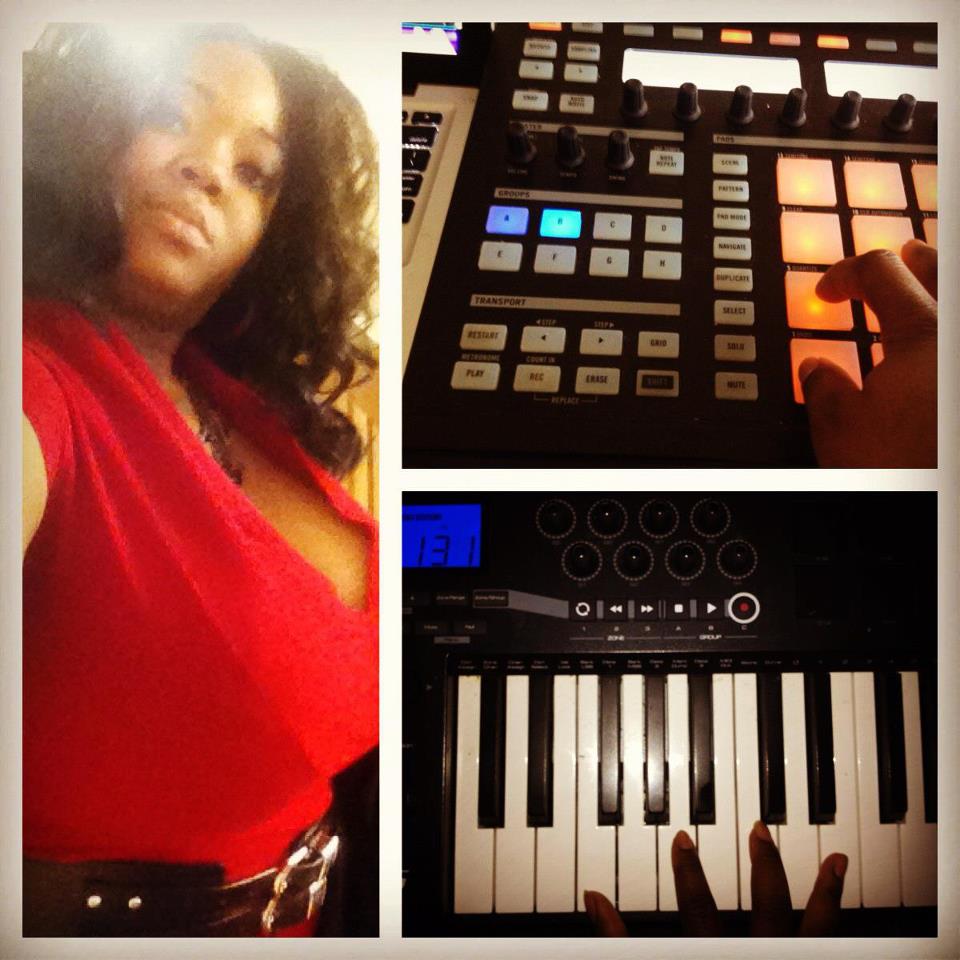
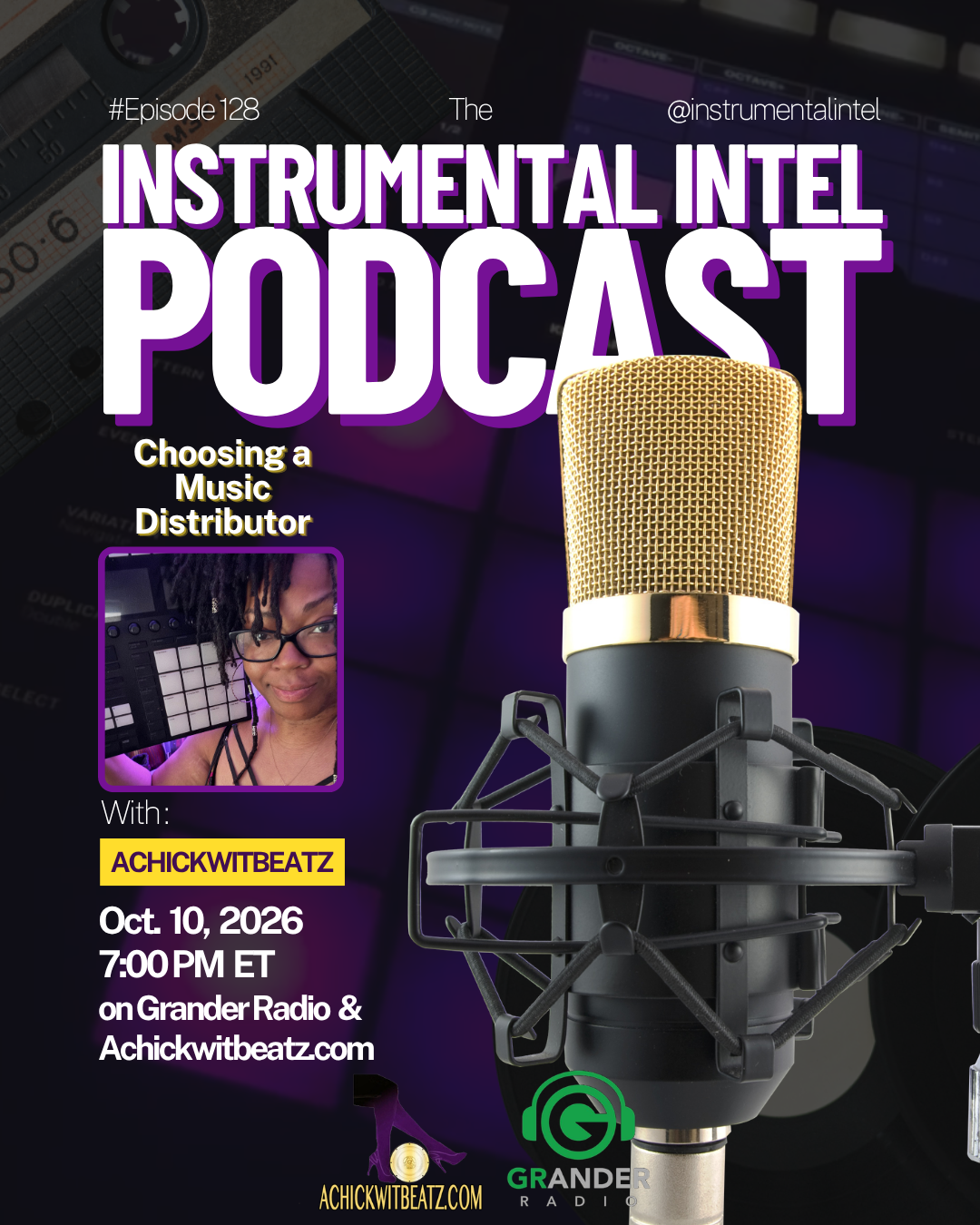
Achickwitbeatz presents the Instrumental Intel podcast, bringing you information instrumental to your artistic career including music industry news & tips, insights & interviews, and beats for your inspiration. Listen on Saturdays at 7 pm EST on Grander Radio and Achickwitbeatz.com.
Follow on Facebook, Instagram, Twitter, YouTube Audiomack & SoundCloud, and subscribe on your favorite podcast platform. Download the Grander Media app to listen to Grander Radio on the go.


- Art
- Independent Labels
- Internet Radio
- Music Documentaries
- Album Reviews
- Music History
- Music Industry News
- Free Game Friday
- Free Downloads
- Poetry
- Books
- Interviews
- Did You See It?!
- Hip Hop History
- Hear Here
- Music News
- Hip Hop Documentaries
- Music Marvels Radio Show
- Think Piece Thursday
- Mini Documentaries
- Instrumental Intel
- Music Humor
- Indie Analysis
- Conversations & Quotables
- Music
- Resources for Artists
- Podcasts
- Beats/Instrumentals
- Music Education
00:00
Hey, thank you so much for tuning in to Instrumental Intel. I'm your host, music producer, Achickwitbeatz, and I'm glad that you're here with me. Today's episode has music industry news, beats by me for your inspiration, and later I'm going to be sharing some information that should be helpful since it's Q4. Everyone's pretty much kind of winding down the year and thinking about ways to strategize for 2027. So today's topic is choosing a music distributor.
00:27
And so yeah, again, I'm excited to be bringing this episode to you. And before I go ahead and drop that first beat, I got to give a shout out to my home station, Grander Radio out of Grand Rapids, Michigan. And with that, let's go.
[BEAT BREAK]
15:21
Hey, I'm Achickwitbeatz, multi-genre music producer and strategist to indie artists and labels. Visit achickwitbeatz.com for resources for artists and instrumentals in various genres available for songs, vlogs, blogs, podcasts, themes, TV, film, commercials, and more. Once again, that's achickwitbeatz.com. That's A-C-H-I-C-K-W-I-T-B-E-A-T-Z.com. Let's make something happen.
15:51
Alright, music producer Achickwitbeatz, back with the Music Biz Brief. First up, Sony Music has sent over 260,000 takedown notices for AI-generated deepfakes of its artists, almost double the 135,000 notices it sent just six months ago in March of 2026. In March of 2025, that number was 75,000, just showing the problem's exponential growth and the need for legislation to lighten the load for labels and management teams.
16:20
Instagram now allows artist teams to boost live broadcasts in-app. The live video is distributed as an ad via feed, reels, and stories to people active on the app at that moment so they can join instantly. In the live composer, teams can tap boost, choose a target audience, or use the Instagram recommendation and set timeframes. Warner Music Group sold merch retailer EMP to media and commerce company whynow, owned by Mick Jagger's son, Gabe Jagger.
16:50
The label acquired EMP in 2018 for $180 million and announced its intent to sell in its February SEC filing. whynow is bringing the 40-year-old rock and metal merch retail business into its portfolio to enable artists and rights holders to manage and grow their audience ecosystem through a single partner spanning merchandising, e-commerce, licensing, and media content.
17:14
Absolute Label Services' white-label AI-powered Anthology business management platform is extending its Music OS to the independent sector. The software uses Anthology's LLM Ant to handle company data and operations, combining digital and physical distribution, neighboring rights registration, marketing, financial reports, supply management, and invoicing. France-based streaming platform Qobuz.
17:40
Now tags AI-generated music and says 60% of streams on those tracks are fraudulent and excluded from royalty payouts with the offending content removed. AI-generated songs get about 0.38% of streams on the service and are excluded from algorithmic recommendations. It also de-indexed 4 million AI-generated songs without streams from its search engine and now they can only be found through direct search.
18:06
Beatport will receive an undisclosed sum investment led by Square Nine to quote-unquote, invest across its platform, products, and broader ecosystem as the company expands its offering for music creators around the world. The electronic music platform hosts live events, provides ticketing services, and is majority owned by XR Capital, also named in Square9's announcement. The firm's website specifies it provides debt investments without taking controlling equity stakes.
18:34
Live Nation is funding Creator Nation, a company that will acquire creator management firms and adjacent businesses. Founders Scott and Alexis Fisher will lead the company, using Live Nation's resources to help creators and their teams turn, quote-unquote, influence into businesses designed to last. The Recording Academy decided to proceed with its new Best Asian Pop Music Performance category at the 2027 GRAMMYs after reconsidering post-pushback.
19:01
Following discussions with K-Pop, J-Pop, C-Pop, and Indian music artists and their teams, CEO Harvey Mason Jr. said keeping the category was the right conclusion for the music community overall. Subsequently, K-Pop group Stray Kids will join BTS in not submitting their music for consideration. The Italian Competition Authority, better known as AGCM, is investigating Suno's Terms of Service to determine if they create a significant imbalance in rights and obligations under the contract
19:31
to the detriment of consumers. AGCM says the terms appear to allow Suno to make unilateral changes to the contract, service, and prices without notice or reason. The terms of service also include a content license requiring users to waive their moral rights, and they have binding terms users can't easily access before signing up. AGCM can issue fines anywhere from 5,000 to 10 million euros for unfair contract terms.
19:58
The Mechanical Licensing Collective, better known as the MLC, will start distributing unclaimed royalties based on market share in April 2027. The Music Modernization Act requires the MLC to hold and attempt to match and distribute unclaimed accrued royalties for at least three years. Royalties from January 2021, which was the first month DSPs reported blanket compulsory mechanical license royalties, and they currently sit at $6 million and will be paid out in April 2027.
20:28
The remaining months will be paid out one usage month at a time. The 8 million AI music and streaming fraud scheme ends with an 18 month prison sentence for Michael Smith and two years of court supervision upon release. Prosecutors say he used thousands of fake accounts on streaming services to stream thousands of AI songs billions of times from 2017 to 2024.
20:50
For example, in April 2023, Taylor Swift had 9.3 million YouTube music family plan streams across her entire catalog, while in the same month, he bought 80.9 million family plan streams for his AI-generated music. The U.S. Copyright Office launched a public inquiry to understand how music streaming fraud works, its economic impact, what industry practices inadvertently contribute to it, and its connection to AI-generated music.
21:19
The notice was published a day after sentencing in the $8 million streaming music fraud case, and on May 21st, Republican U.S. Rep Scott Fitzgerald requested an inquiry to quote-unquote, examine the contributory effects of artificial intelligence and music streaming fraud and the resulting effect on the music industry. So, the public must submit initial written comments by November 23rd and reply comments by December 21st.
21:46
So if you want to contribute, please make sure to pay attention to those deadlines and check out more information at the U.S. Copyright Office website. All right, that's a wrap for the Music Biz Brief. I'm going to take a quick pause for the cause and then I'll be back with things to consider when choosing a music distributor. Keep it locked.
[BEAT BREAK]
31:12
Hey, I'm Achickwitbeatz, multi-genre music producer and strategist to indie artists and labels. Visit achickwitbeatz.com for resources for artists and instrumentals in various genres available for songs, vlogs, blogs, podcasts, themes, TV, film, commercials, and more. Once again, that's achickwitbeatz.com. That's A-C-H-I-C-K-W-I-T-B-E-A-T-Z.com. Let's make something happen.
31:42
Hey, music producer Achickwitbeatz back as promised with things to consider when choosing a music distributor. So first off, picking the right music distributor is an important decision for indie artists because essentially they're the link between your songs and the many streaming platforms, online stores, and sometimes even sync licensing opportunities. So it's a decision that affects your reach, your revenue, your rights management, and overall control.
32:10
So I've been researching music distribution options, both for my own releases and also for other artists who need help trying to navigate all the choices. So in order to make an informed choice, we've got to dig deeper than just the popularity of the platform, but to consider the practical trade-offs and how they align with your own personal music career goals. So, you know, lot of online discussions kind of suggest that a lot of people think of a music distributor as pretty much just a delivery service, but it's actually a little deeper than that. The distributor you work with can affect
32:40
your availability on platforms. For instance, not all distributors work with every streaming service or digital store globally. So some focused on broad reach while others might specialize in niche or emerging markets. It affects the timing of your releases. can change depending on the distributor. So some services can have your music live within days.
33:04
And in one case that I've experienced with LANDR, even hours, while others can take weeks. So this affects your marketing calendar and basically how quickly you're able to capitalize on any momentum that you have. It also affects your payment flow and transparency. Your income depends on royalty collection, payout frequency, and reporting clarity. So hidden fees or delayed payments can disrupt your cash flow, which is something that I'm currently experiencing with Ditto.
33:33
And part of the reason why I've been researching distributors. So yeah, something to consider. It affects the control you have over your music. Whether or not you retain ownership of your masters, your metadata accuracy, the ability to update or remove your releases. All of those things are important for long-term career flexibility. And finally, it also affects additional tools and opportunities.
34:00
So some distributors offer extras like playlist pitching, sync licensing portals, or marketing resources that can kind of help growth at an additional cost. So yeah, making the wrong decision can limit your earning potential, could delay your releases, or reduce your control. All these things that can end up costing you both financially and creatively. So this means the first thing that you need to do is decide your music distribution goals and needs.
34:25
So in order to compare effectively, you have to evaluate what your goals are to make sure that you know exactly where your priorities lie. So this includes target audience and territories. Like, are you aiming for a global audience or specific countries? Some distributors have a stronger presence or better terms in certain regions. For example, a distributor with strong connections in the minimum music market might be essential if that's where you're trying to grow. The formats that are required.
34:53
Digital-only releases are standard, but if you're planning to sell physical formats like vinyl, cassettes, CDs, you know, that kind of stuff, check to see if the distributor supports physical distribution or partners with other fulfillment services. What's your release frequency? If you release multiple singles or albums a year, a subscription model might be more cost-effective than paying for each release. So on the opposite end of that, if you use sporadically released music, per-release pricing might work better for you.
35:22
And then will you need additional services? So features like YouTube Content ID, playlist pitching, sync licensing, all that stuff can be valuable, but not available everywhere. So you have to figure out if these are things that are going to align with your strategy or if a standalone service just might work better for you. So yeah, basically kind of knowing your priorities keeps you from paying for unnecessary extras and overspending on stuff that you don't need.
35:48
All right, then the next step is to evaluate pricing models in relation to your budget and your release plan. So music distributors typically follow one to three pricing structures. There's the annual subscription where you pay a flat fee every year to upload unlimited music. So this works for a lot of artists or labels that are kind of prolific, you know, doing their thing kind of frequently. However, if you pause releasing, you still pay to keep your catalog active. Then there's the per-release fee.
36:16
So you pay once per album or a single to distribute indefinitely. So this model avoids the recurring costs that you get, but it can add up if you start to release more frequently. And some distributors charge optional annual fees to maintain releases. And then there's also commission-based. So there's no upfront fees, but the distributor takes a percentage, usually 10% to 15% of your royalties. So this lowers the initial cost, but it does reduce your total earnings.
36:47
So I guess basically consider your release frequency and your long-term budget. If you release once a year per-release might be cheaper. If you release monthly, subscriptions could save you some money. So yeah, just kind of thinking about your cadence and your finances will help you pick the best option that you can actually sustain. Step three: analyze royalty policies, collection, payout frequency and transparency. How your royalties are handled can make a big difference to your cashflow.
37:16
So getting paid accurately and on time is really important. So think about royalty payment frequency. Since it varies, some distributors pay monthly, others quarterly, others only after reaching a minimum payout threshold. Sometimes, you know, 50, 100 bucks depends on the distributor. I've seen as low as 20 in some cases. But delays or high thresholds can of course potentially create some cashflow problems. Think about payment methods include bank...
37:45
transfers, PayPal, wire payments, or even checks. Just verify which are available and if there are any that carry any fees or delays, especially for international artists. You also want to consider currency handling. It's important if your royalties are collected in multiple currencies. So some distributors charge fees to convert earnings to your preferred currency. And to check their reporting transparency.
38:11
It means you should be able to get detailed royalty reports that break down earnings by platform, country, time period, all that information. So it's important for auditing and to make sure that you're understanding exactly where your revenue is coming from. Typically, poor royalty management is a common complaint among artists and it damages trust. So always make sure you read the fine print and make sure that you're checking out artists feedback about how reliable they are with payments. Reddit is a great place for that.
38:41
Alright, then the next step is to confirm your rights and metadata are fully controlled. You know, owning and controlling your music matters. So you gotta make sure that you understand rights ownership. Your agreement should explicitly state that you keep 100% of your master rights. The distributor acts only as your agent for sending or delivering your music. You wanna make sure that you have metadata control. Make sure that it's accurate, song titles, contributor credits, ISRC...
39:10
All that stuff guarantees that everybody involved is correctly credited and compensated. So any mistakes here can delay payments, misattribute works and money. can be a whole mess. And then you also want to make sure that you have the ability to remove or update releases. So you need the flexibility to withdraw your music or correct metadata errors without penalty or delay because some distributors will lock you in or make changes kind of difficult.
39:37
So yeah, strong metadata management is one of those things that kind of tends to get overlooked when people are considering distributors, but it's really important for royalty accuracy and future licensing deals. Then the next step is to research customer service responsiveness and support quality.
39:53
So again, another thing a lot of people kind of overlook is customer support until they actually need it. So when you have a release that runs into trouble, it gets slow or you get unhelpful service, it can cause delays. And so it's better to try to proactively check this stuff out before you commit to a distributor. So check out their initial responsiveness. Reach out with a pre-sale question, like about fees, features, or policies. Basically a distributor's willingness and speed to answer can kind of signal how they're going to treat you long-term.
40:23
So some distributors offer live chat or phone support. Others only email tickets, AI agents, which is a problem I've recently ran into with Ditto. And yeah, if quick answers matter to you, make sure that you test these things out early. The other thing you want to check is ongoing support access. So once you've signed up, try contacting support with something that's not urgent to kind of gauge how thorough they are and how quickly it takes for them to get back to you. So most artist complaints
40:52
come from automated responses or slow ticket resolution, which I mean, we've all encountered at some point somewhere, but knowing this upfront kind of lets you be able to plan for contingencies if issues come up later. Check out their educational resources. Good distributors provide detailed help centers, tutorials, FAQs, community forums, all that stuff. So they can keep you from having to rely directly on support and kind of help you solve the problems on your own.
41:19
If there's no solid resources, it could mean that you'll spend more time kind of stuck. Yeah, just something to consider. And also check out their problem resolution track record. Browse forums and social media to find artist feedback about how distributors handle payment errors, metadata corrections, or release delays. So a responsive team will answer, actively resolve issues, and communicate progress. If that's not happening, you might want to keep looking. So yeah, choosing a distributor,
41:49
that's got reliable and accessible support kind of keeps things running smoother for you. And the next step, you want to kind of carefully assess their additional features and tools. A lot of times they advertise bonus services and extras to kind of differentiate themselves from the competition, but you just need to make sure that these perks are, you know, something that's going to benefit you and your specific needs at your current career stage.
42:16
So, you know, playlist pitching portals, some distributors offer like the built-in pitching, but success rates vary. And so these platforms tend to have like limited curator networks or charge extra fees. So if playlisting is something that's important to you, you might want to consider independent pitching services or just building direct relationships with other curators. Uh, YouTube Content ID. Monetizing YouTube views via Content ID can be really lucrative if your music gets used in videos a lot. So.
42:46
Just double-check to make sure that your distributor service can include global claims if they take any cut beyond the standard fees and all that good stuff. Like, sync licensing marketplaces. A lot of them offer this. You know, access to the opportunities in film, TV ads, games is appealing, but make sure the quality and the volume of leads match up with what you're looking for because that can vary depending on the distributor.
43:13
So make sure that you're watching out for distributors that require you to exclusively work with them on that or high commissions in exchange for sync placement. There's a lot of times dedicated sync agencies or platforms can give you more focused service and results instead of trying to lump that in with your distributor. Marketing and analytics tools: some distributors bundle dashboards with streaming analytics, social media integrations, marketing credits, and that kind of thing.
43:42
So these help indie artists make decisions based on data, but they're not necessarily like essential early on. So it depends on where you're at and what you're looking to do. So yeah, basically in short, make sure that before you pay extra for distributors with these features, see if it matches up with what you're trying to do right now. The last step is basically, know, compiling the artist reviews, community feedback for actual insights.
44:13
Um, so yeah, that's been one of the most valuable parts of my research is hearing from artists who've lived through different distributor experiences. So you want to search multiple sources. Like earlier, I mentioned forums like Reddit. Um, one specifically that can be helpful is the, um, r/WeAreTheMusicMakers. Um, there are Facebook groups for indie musicians and music industry blogs discuss this kind of thing a lot. Uh, Discord.
44:41
So yeah, just make sure that you're checking out recent posts or anything that kind of offers details that seem reliable. Then you want to look for patterns. Pay attention to if they're getting the same compliments or the same complaints, especially about royalties, customer service. A single bad comment could be an outlier, but if there's consistent reports, there's a good chance that there might be some systemic issues there.
45:11
And as always consider your specific situation if an artist that's got a similar release schedule, genre, or market as you. If they have any feedback about distributors, you may want to check it out to help you with your decision. Beware of outdated or sponsored reviews. The music distribution marketing field is getting kind of crowded. So a lot of times they offer reviews that aren't necessarily legit.
45:40
And usually they're not really that hard to spot, especially on Reddit when that happens. You know, if it seems like somebody's gassing up a company in a way that most people don't typically talk about other companies in that same kind of passion, it's a good indicator that, um, yeah, they're undercover. So yeah, combining community feedback with official information can kind of help you avoid surprises. So basically it boils down to
46:09
choosing one that matches exactly what you need as opposed to what's popular. It should feel like a partnership that supports your music's reach, your revenues, reliability, and basically your creative freedom. So focus on these core priorities. Make sure that royalty payouts are timely and transparent, clear reporting. You own your masters and you have full metadata control. Pricing aligns with your release rhythm and your budget.
46:39
You want responsive and helpful customer support and features that genuinely add value to what you're trying to accomplish. So yeah, when you're taking the time to research, make sure that you're weighing these factors. can give you, um, the wisdom you need to kind of avoid pricing mistakes, make sure that you get your releases out smoother and support your long-term career growth. All right. We're going to get back to the beats and then I'll be back to close out the episode. Keep it locked.
[BEAT BREAK]
59:42
Alright that's a wrap for this episode. Once again I want to thank you for tuning in. I'd like to thank my home station Grander Radio out of Grand Rapids, Michigan. Make sure you come back next week. I got more goodness lined up for yourself. Till next time you know where to find me. Tune in, tell a friend and I'll see you then. Peace.


![Hear Here: Achickwitbeatz - Dopamine & Serotonin [Single]](https://images.squarespace-cdn.com/content/v1/52b0b90ae4b0293bfed0d692/1710852808557-EZYGFDIBHLBSIRFOVS1Q/Dopamine+%26+Serotonin.JPG)







![Hear Here: Dagga Man- "Analytics" [Prod. by Achickwitbeatz]](https://images.squarespace-cdn.com/content/v1/52b0b90ae4b0293bfed0d692/1584638158548-9R55AZLWZIDFJC8LATV6/IMG_2212.JPG)







![Making Music on a Budget [Infographic]](https://images.squarespace-cdn.com/content/v1/52b0b90ae4b0293bfed0d692/1582844361438-3JTE5NT3EL51FHXC0WJI/making-music-on_1929722%25281%2529.jpg)


A homage to the golden era of 1990s instrumental beat vinyl. Crafted as the perfect partner for freestyling MCs, dancers, and DJ culture. | Visit Achickwitbeatz.com for your instrumental needs & dope stuff for music lovers.