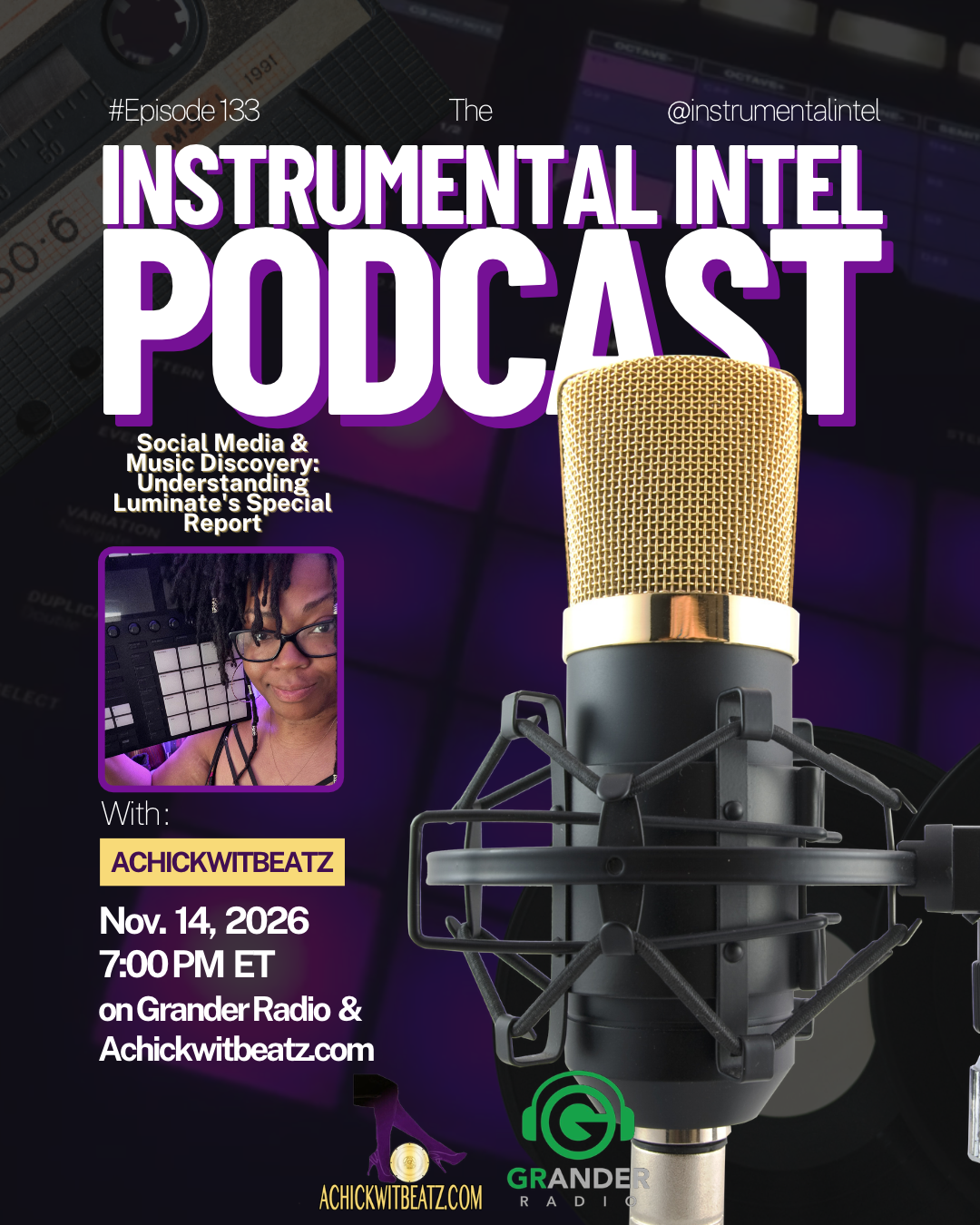
Achickwitbeatz presents the Instrumental Intel podcast, bringing you information instrumental to your artistic career including music industry news & tips, insights & interviews, and beats for your inspiration. Listen on Saturdays at 7 pm EST on Grander Radio and Achickwitbeatz.com.
Follow on Facebook, Instagram, Twitter, YouTube Audiomack & SoundCloud, and subscribe on your favorite podcast platform. Download the Grander Media app to listen to Grander Radio on the go.


- Art
- Independent Labels
- Internet Radio
- Music Documentaries
- Album Reviews
- Music History
- Music Industry News
- Free Game Friday
- Free Downloads
- Poetry
- Books
- Interviews
- Did You See It?!
- Hip Hop History
- Hear Here
- Music News
- Hip Hop Documentaries
- Music Marvels Radio Show
- Think Piece Thursday
- Mini Documentaries
- Instrumental Intel
- Music Humor
- Indie Analysis
- Conversations & Quotables
- Music
- Resources for Artists
- Podcasts
- Beats/Instrumentals
- Music Education
00:00
Hey, thank you so much for tuning in to Instrumental Intel. I'm your host, music producer, Achickwitbeatz, and I've got a special episode for you. Today, I've got music industry news, beats by me for your inspiration, and later I'm gonna be sharing some information about a recent report released by Luminate called Social Media and Entertainment Discovery, How U.S. Audiences Find Music, Movies, and TV Shows on Short Form Video Platforms.
00:26
And so we're gonna kind of dig into what that means for us as independent artists and things that we should know that would be helpful to help us market our music on social media. So I'm excited to be bringing this episode to you. And before I go ahead and drop that first beat, I've got to give a shout-out to my home station, Grander Radio out of Grand Rapids, Michigan. And with that, let's go.
[BEAT BREAK]
16:44
Hey, I'm Achickwitbeatz, multi-genre music producer and strategist to indie artists and labels. Visit achickwitbeatz.com for resources for artists and instrumentals in various genres available for songs, vlogs, blogs, podcasts, themes, TV, film, commercials, and more. Once again, that's achickwitbeatz.com. That's A-C-H-I-C-K-W-I-T-B-E-A-T-Z.com. Let's make something happen.
17:14
Hey music producer Achickwitbeatz back with the Music Biz Brief. First up, generative AI music platform Suno is being sued for copyright infringement by Elvis Presley Music Rights Holders and Eminem Music Publisher 8 Mile Style LLC. The Presley complaint also alleges identity exploitation under Tennessee's 2024 ELVIS (Ensuring Likeness, Voice, and Image Security) Act, as Suno allows users to cite his name when generating new songs.
17:40
The compounding lawsuits haven't hurt the platform's market value, which is $5.4 billion after receiving $400 million in funding in June. It'll be interesting to see how this plays out. YouTube will return to Billboard's US charts now that Billboard has corrected its free versus paid streaming ratio following a formula change in December of 2025. At the time, it lowered its 1 to 3 ratio, so that was 1,250 paid streams or...
18:08
3,750 ad-supported streams per album unit to 1 to 2.5, prompting YouTube's Global Head of Music, Lyor Cohen, to announce the platform would stop supplying data to Billboard until it accurately reflected how fans engage with music. The new ratio will be 1 to 1.5, so that's 1,000 paid subscription streams, or 1,500 ad-supported streams per album unit for the Billboard 200 beginning January 16th of 2027.
18:38
which will include data from January 1st to January 7th. A judge dismissed the lawsuit from an artist who claimed he purchased a $200 10-year exclusive beat license on the beat marketplace Traktrain in 2019 for the instrumental used in Babyface Ray and 42 Dugs Ron Artest, which was then sampled in Flo Milli's 2023, Never Lose Me, because the producer never signed the agreement. Dismissed with prejudice,
19:05
The case listed the producer and all three artists as defendants. The Traktrain-generated license was signed by owner and operator Nick George, whom Sony argued wasn't authorized to sign on the producer's behalf. Sounds like a right decision, but also a fair warning to anybody purchasing beats through those marketplace sites that something like this can happen. So make sure that you're reading the terms and agreements and that you have everything in place so that way you don't run into situations like these…
19:34
or buy directly from producers like me – shameless plug there. Alright, and finally, Sound Exchange's 2019 lawsuit against Music Choice alleging underpaid royalties returns to court. The Copyright Royalty Board, or CRB, requires business establishment services, known as BES, like Music Choice, to pay rights holders a percentage of earned revenues as royalties. Sound Exchange says Music Choice paid only a fraction of its BES revenue.
20:02
as it excluded its TV service channels. The judge paused the case in December 2021 until the CRB could determine what the rule meant to them. Three years later, in December 2024, the CRB ruled in Sound Exchange's favor. Music Choice's attempt to challenge the decision was rejected in August 2026. November 2nd, both companies filed a report requesting 75 days to exchange evidence, discuss settlement options, or mediation.
20:28
And it's scheduled to wrap up in early March 2027, so we'll have to see what happens then. All right, that's a wrap for the Music Biz Brief. I'm going to take a quick pause for the cause, and then I'll be back with a special segment on social media and music discovery, Understanding Luminate's special report. Keep it locked!
[BEAT BREAK]
41:09
Hey, I'm Achickwitbeatz, multi-genre music producer and strategist to indie artists and labels. Visit achickwitbeatz.com for resources for artists and instrumentals in various genres available for songs, vlogs, blogs, podcasts, themes, TV, film, commercials, and more. Once again, that's achickwitbeatz.com. That's A-C-H-I-C-K-W-I-T-B-E-A-T-Z.com. Let's make something happen.
41:39
Alright, I'm music producer Achickwitbeatz back with Social Media and Music Discovery: Understanding Luminate's Special Report. So, Luminate released a report called Social Media and Entertainment Discovery: How U.S. Audiences Find Music, Movies, and TV Shows on Short Form Video Platforms. So, the main discoveries highlighted include: streaming services are still the top discovery source overall, but social media and short-form video platforms are a close second for some fans.
42:09
Another highlight: social media and short-form videos have a bigger impact on discovery for young audiences, specifically Gen Z. And a third highlight: social media appears to be a prominent discovery source for audiences who are more likely to pay for entertainment via subscriptions, physical music and merch, and live events. So one of the main things to kind of keep in mind is that music consumption preferences vary by age, but streaming is the most prominent.
42:36
which includes listening to songs on DSPs, and that's digital service providers, or music videos on YouTube. So when you get into the age and preference breakdown, the 18-24-year-olds' preference by rank is number one: streaming songs and playlists online via DSPs, and that's, you know, Spotify, Apple Music, all those, and about 84% of the group surveyed in that age range says that that's how they do it.
43:04
Number two is streaming music videos online via YouTube, etc., and that number came in at 69%. Number three: watching short music video clips on socials. That includes TikTok, YouTube Shorts, Reels, all those things. That total came in at 58%. Number four was AM/FM radio at 36%.
43:28
Number five was watching music videos on TV. So this includes your MTV, VH1, Fuse, all those. And that came in at 22%. In the next age group category, 25-34-year-olds, their preferences by rank, the order really wasn't different, but just the percentages kind of changed. So number one was streaming songs and playlists online. That was at 69%. Number two was streaming music videos online, 71%.
43:57
Number three: watching short music video clips on socials at 52%. Number four, AM/FM radio at 46%. Number five, watching music videos on TV at 24%. So now, when you get to the 35-44 year olds’ preferences by rank, here's where we begin to start seeing a slight shift. So number one is streaming songs and playlists online via DSPs at 75%. Number two is music videos online at 70%.
44:27
Number three is AM/FM radio at 56%. Then number four is watching short music video clips on socials at 49%. And number five is watching music videos on TV at 26%. Then next we have 45-54 year olds’ preferences by rank. And there's another shift this time. Number one, streaming music videos online. So that's already a little bit different there, instead of going to digital service providers…and that came in at 69%.
44:57
Number two was streaming songs and playlists online via DSPs. That came in at 64%. Number three, AM/FM radio at 62%. Number four: watching short music video clips on socials at 40%. Number five, watching music videos on TV at 21%. Now the 55- 64-year-olds ' preference, this group's number one: AM/FM radio at 64%. Their number two:
45:27
streaming music videos online at 56%, number three, streaming songs and playlists online via DSPs at 49%, number four, watching short music video clips on socials at 26%, and number five: watching music videos on TV at 14%. And finally, the 65 and up crowd: number one, AM/FM radio at 63%, number two: streaming music videos online at 44%,
45:55
Number three: streaming songs and playlists online via DSPs at 40%. And number four: watching short music video clips on socials at 19%. And number five: watching music videos on TV at 10%. So one thing I noticed is that, regardless of age, discovering music by watching TV through the traditional channels that some of us seasoned artists are used to came in last. So for every single age group, that's not really the way most of them are doing it anymore.
46:23
Which, if you would have told some of us this in our younger years, we probably would have laughed and shrugged it off, but here we are. Alright, now the top music discovery sources for U.S. music listeners to find new music and artists. Number one: video and/or audio streaming services. So, of course, your Spotify, YouTube, all that other stuff. And that's 40%. Number two: AM/FM radio at 39%. Number three is through friends and relatives at 38%.
46:52
Number four is traditional social media sites and apps like Facebook, Twitter at 37%. Number five: short-form social video sites and apps like TikTok at 33%. Tied with movies and movie soundtracks at 33%. And finally, television at 30%. So now, to dig a bit deeper into what I found to be the big highlight to pay attention to, is that high-value audiences, and those are the ones that have music streaming subscriptions,
47:20
they buy physical copies and attend live shows. They're more likely to find new artists and music via socials and short-form video platforms than the average listener. So the report kind of breaks down how these unicorns find music based on how they spend their money. So for the paid music streaming subscribers, the top method is video and/or audio streaming services at 45%. Second, traditional social media at 45%, and the third: short-form social video at 42%.
47:48
For the physical music purchasers, their top method is video and/or audio streaming services at 51%. Second, traditional social media at 50%. Third, short-form social video at 43%. And then for the ones that attend live music events, their top method is traditional social media at 65%. Second, video and/or audio streaming services at 63%. And third, short-form social video at...
48:17
60%. So one of the big things to take away at least from that last little tidbit if you've got a live music event that you want to promote, social media is going to be the best way to actually reach the audience that would be willing to pay and purchase tickets. So yeah, it's helpful to know where those high-value fans are more likely to discover you and support your music monetarily. Alright, when it comes to the most popular music-based activities on social media by age, the top one is watching videos about music artists, and this includes your
48:46
behind-the-scenes tidbits and any other types of videos that you do that kind of tell a little bit more about yourself and your music. So ages 18-44, that figure came in at 38% and for ages 45-65 and up came in at 28%. The next one is listening to music friends have posted, and about 37% of ages 18-44 take part in that and 28% of ages 45 and up
49:16
participate in that activity. Next is following music artists and/or fan pages, and 36% of those aged 18-44 participate in that. And 24% for 45 and up. And finally, listening to music artists perform live, and so this means your Instagram Lives, Facebook Live, whatever the case is, about 29% of those ages 18-44 participate and watch that online…
49:45
and 19% of ages 45 and up. So, a lot of us use social media to be able to promote what we do. And of course the goal is that when people find you, you want them to search for you. And so this report actually shows how likely people are, based on their age ranges, to do that. So yeah, the 18- 24-year-olds are 39%.
50:09
likely to search for you after finding you on social media. 25-34 come in at 32%. 35-44 at 34%. 45-54 at 29%. And 55-64 at 23%. And 65 and up came in at 13%. Alright, now when you kind of dig into behaviors after discovering music on social media, the report breaks it down from music listeners. So that's pretty much
50:39
casual fans compared to those who engage in four or more music-related activities on social or short-form video apps and sites. So, after discovering on social media to go and listen to the artist's other music, about 58% of music listeners do this, but when it comes to the high-value audience, 69% do. To add new music or artists to their playlist, 44% of casual music fans…
51:08
59% of the high-value do. Or sometimes just listening to the specific song, 43% of casual listeners will do that compared to 50% of the high-value audiences. Following the artist on social media: 35% of casual music listeners will do this, and 54% of the high-value audiences will do this. Share
51:31
the new artist or music with friends or family: 34% of casual listeners will do this, compared with 52% of the high-value audiences. And seek out more social media content that includes that artist or music: 32% of casual listeners do this, compared with 51% of the high-value audiences. And finally, share the new music on their personal socials: 26% of casual listeners do this compared with 43% of the high-value audiences.
52:00
So yeah, these figures are important to know and kind of understand how people interact with it. I do plan on covering later the difference between, like, vanity metrics and the ones that you need to pay attention to. And these are definitely part of the ones that you should actually pay attention to because somebody connecting with your music actually goes deeper than just a like or a follow. All of these things are important to pay attention to help you reach your goals in your music career.
52:28
Alright, and that's a wrap for this portion of it. If you want to know more information, I encourage you to check out the full report on Luminate's website. Alright, I'm gonna get back to the beats, and then I'll be back to close out the episode. Keep it locked.
[BEAT BREAK]
59:40
Alright, that's a wrap for this episode. I've been your host, music producer, Achickwitbeatz, and once again I want to thank you so much for tuning in. I'd like to thank my home station, Grander Radio out of Grand Rapids, Michigan. Make sure you come back next week. I've got more goodness lined up for you, so next time you know where to find me. Tune in, tell a friend, and I'll see you then. Peace.




















Via Nylon Trax: Achickwitbeatz returns to Nylon Trax with “Show Me.” The Kalamazoo, Michigan producer, songwriter, and vocalist has always had a way of bringing her own musical language to house music — soulful without being predictable, electronic without losing its humanity, and always grounded in groove. | Visit Achickwitbeatz.com for your instrumental needs & dope stuff for music lovers.